

How to Choose the Right Bass Fishing Rod
How to Choose the Right Bass Fishing Rod
Bass fishing rods come in a wider range of powers, actions, tapers, and lengths than any other freshwater species. This guide breaks down every variable — and how they work together — so you can match the right rod to the technique and fish it with confidence.
Last updated: August 2026 · By: Jason Sealock
What This Guide Covers
Bass fishing rods come in a wide range of brands, actions, powers, tapers, and lengths. That can make the process of choosing the right rod a bit cumbersome — especially to anglers just getting into the sport. Even some long-time anglers don’t fully understand the nuance of taper, length, and power combinations as they apply to making certain techniques more efficient and effective.
This guide covers the full picture:
- Power, action, taper, and length combinations and what they do
- How materials affect performance and price
- Why rod and reel balance matters more than most anglers realize
- Technique-specific rod selection for every major bass fishing application
- Popular bass fishing rod brands and what sets them apart
- How to think about rod budgets and price points
At the core of any rod selection is understanding the four variables that determine how a bass rod will behave on the cast, retrieve, and hookset:
| Characteristic | What It Controls | Key Trade-off |
|---|---|---|
| Power | Stiffness & backbone; hookset and landing power | Heavier power = more driving force, harder to cast light lures |
| Action | Tip rebound speed | Fast = stiffer tip, immediate response; slow = softer tip, loads lighter lures |
| Taper | Where and how the rod bends along its length | Fast taper = bends at tip only; slow (parabolic) = bends evenly tip to butt |
| Length | Casting distance, leverage, and reach | Longer = more distance & leverage; shorter = more accuracy & maneuverability |
The 4 Core Rod Characteristics
Rod Power
Power — sometimes loosely referred to as backbone — refers to how much stiffness is built into the base of the blank. It gives you landing power, hookset power, and casting power. A heavy power rod has a much stiffer blank at its base than a light power rod. That heavy power makes setting the hook easier and gives you the authority to land bigger fish. However, it makes casting lighter lures much more difficult. Conversely, a light power rod can throw a light lure much farther, but it requires smaller hooks to get a good hookset — the rod will bow significantly more on the swing, which limits how hard you can drive a hook.
Action
Action refers to the rebound of the rod tip. A fast action rod means the tip reacts and rebounds very quickly to movement — it’s stiffer and more suited for casting heavier lures or for applications like pitching short distances. A slow to moderate action means the tip loads much more slowly and rebounds more gradually, which lets it cast lighter lures but limits its performance with heavier weight lures.
Taper
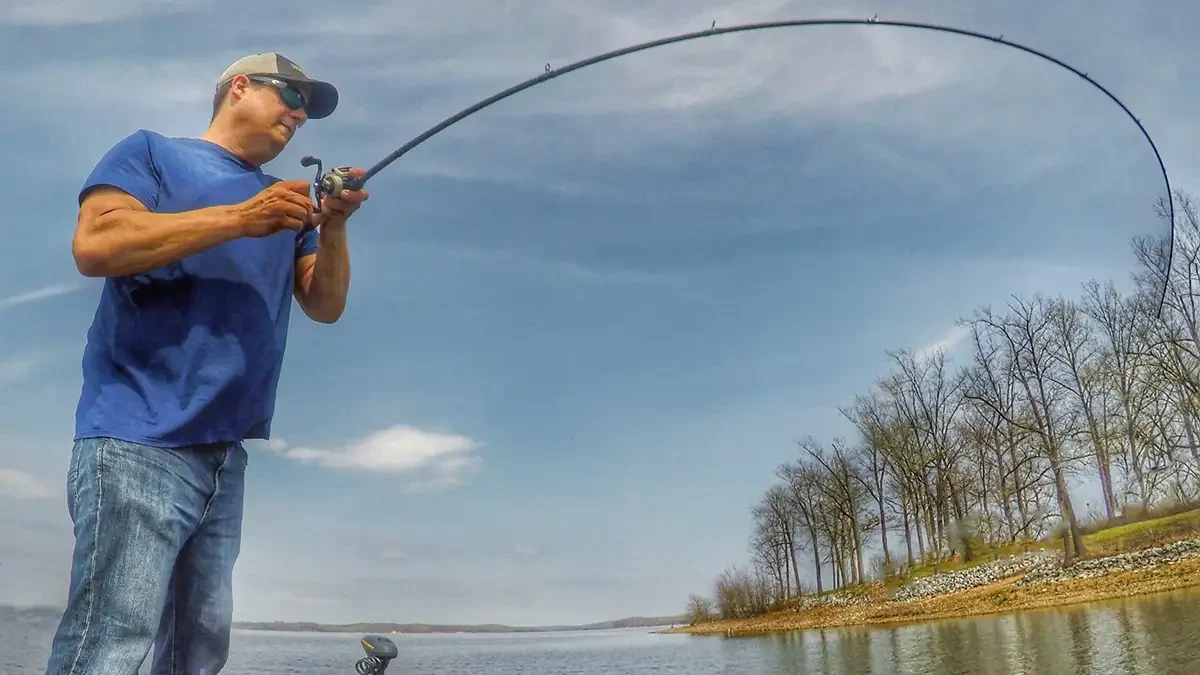
Taper refers to how the rod bends throughout the entire blank. A fast taper means the rod bends only slightly at the tip. A slower or more parabolic taper means the rod bends more evenly from tip to butt. Taper affects how the rod loads on the cast and how it reacts on a strike and hookset. Manufacturers often incorporate slower tapers on lures that move quickly through the water and typically carry treble hooks. With those lures, the fish need more time to engulf the bait and close their mouth before the angler drives the hooks. A fast-taper rod loads much faster and can snatch a lure away before that happens. So it’s more suited to direct-contact lures like jigs and worms.
Rod Length
Length factors in through the cumulative effect of all four characteristics working together. Take a 6-foot ultralight and an 8-foot ultralight: the 8-foot rod will throw the same lure farther because the extra length allows the blank to load more. Length can also help you handle larger lures a little more easily and gives you an easier pendulum for precise presentations like pitching and flipping. A longer rod can also move more line on a hookset — which makes it ideal for techniques like the Carolina rig or whenever you need to pick up slack quickly through cover.
The combination matters more than any one variable. Two rods with the same power rating can feel and fish completely differently depending on their action and taper. Always consider all four together — not any one in isolation.
Materials & Construction
Most bass fishing rods are built from some version of graphite and/or other blended materials. The grips can be wrapped in materials that affect sensitivity, comfort, and performance. EVA foam varies in density, which affects feel, sensitivity, and hand fatigue differently than cork — and cork itself varies considerably in quality.
Some rod manufacturers add carbon fiber into their blanks to improve rigidity and durability while also boosting sensitivity. This typically raises the price but delivers measurable performance gains — and it changes the action and power characteristics compared to straight graphite, which can be more brittle.
Manufacturers also use fiberglass for certain applications and even exotic materials like bamboo. Fiberglass is usually a slower action and lighter power than a similarly rated graphite rod — which actually makes it ideal for treble hook crankbait fishing, where you want the rod to absorb the strike and load slowly before the hookset. Bamboo can be a bit more responsive but is more brittle than both.
Other construction details matter more than anglers often realize:
- Through-blank construction lets you make direct contact with the rod blank through the handle, improving bite detection significantly
- Guide selection — ceramic inserts vs. stainless steel — affects both weight and line wear
- Grip design and cut affect overall rod weight, which changes how the rod balances and how it feels over a long day on the water
| Material | Sensitivity | Weight | Best For |
|---|---|---|---|
| High-modulus graphite | Excellent | Very light | Finesse, jigs, direct contact |
| Graphite / carbon fiber composite | Very good | Light | Most bass applications |
| Standard graphite | Good | Light–moderate | General purpose |
| Fiberglass | Moderate | Heavier | Crankbaits, treble hook lures |
| Fiberglass / graphite composite | Good | Moderate | Crankbaits, moving baits |
Rod & Reel Balance
Once you have a rod selected, the reel you pair with it can affect its performance significantly. If a rod is tip-heavy, you’ll want a heavier reel to balance it. Ideally, a rod should balance just past the reel seat — so when your hand is on the rod at or slightly above the reel, the rod isn’t constantly torquing on your wrist. A tip-heavy setup fatigues you faster and can increase the risk of long-term repetitive injuries like tennis elbow or carpal tunnel.
Balancing a rod is a critical component to managing the efficiency of fishing it for long periods of time. A well-balanced rod and reel combo will fish much more comfortably than a tip-heavy or butt-heavy combination. This is a factor that rarely shows up in spec sheets but becomes very apparent after a full day on the water.
Quick balance check: Hold your rod at the reel seat with two fingers. If the rod tips forward, it’s tip-heavy and you need a heavier reel. If it tips back, the reel is too heavy for the rod. A properly balanced combo will balance almost flat at the grip.
Technique-Specific Rod Selection
Bass fishing has arguably the widest range of techniques of any freshwater species — which is exactly why it has the widest variety of rod power, action, taper, and length combinations. Many rods today are built technique-specific. Here’s how to think about the match for each major category:
Light Power, Slower Action — Finesse Applications
Light and medium-light power rods are best suited for lighter line and lure applications — small topwaters and jerkbaits, as well as finesse presentations like drop shots and ned rigs. The softer tip allows these lighter lures to load the rod properly on the cast, and the lighter power doesn’t overpower smaller hooks. Longer rods in this range can give you more casting distance when you need to reach fish in open water.
Medium Power, Moderate to Moderate-Fast Action — Treble Hook Moving Baits
Medium power rods with moderate to moderate-fast actions are best suited for moving, treble-hook lures — deep-diving crankbaits, lipless crankbaits, and straight-retrieve topwaters like Whopper Ploppers. The moderate action gives fish time to engulf the bait before the angler loads the rod, and the softer taper absorbs head shakes without pulling hooks. Chatterbaits can also fish well on this setup.
Medium-Heavy Power, Fast Action — Single Hook Moving Baits
Medium-heavy power, fast action rods are suited for slightly heavier lures with single hooks — spinnerbaits, Chatterbaits, swim jigs, and topwaters that you work with the rod like a walk-the-dog or jerkbait. A slower-action, lighter rod will wear you out if you’re popping the rod tip all day to work a surface bait. The general rule: you want a faster action when the rod does a lot of the working of the lure, and a heavier power when you need to drive a single hook firmly.
Heavy Power, Extra-Fast Action — Heavy Cover & Big Lures
Heavy power rods with extra-fast actions are for heavy line and braid applications and for throwing bigger lures: frog fishing over matted vegetation, pitching jigs and soft plastics into thick cover, skipping lures under docks, and throwing oversized glide baits or heavy swimbaits. These rods let you drive a hook through cover and steer big fish away from potential break-offs quickly. Nobody expects to catch a 20-pound bass — but a heavy power rod on 20-pound line gives you a fighting chance when a giant is buried in cover with a dozen ways to break you off.
| Technique | Power | Action / Taper | Typical Length |
|---|---|---|---|
| Drop shot / Ned rig | Light – ML | Fast / parabolic | 6’10” – 7’2” |
| Small jerkbaits / topwater | ML – Medium | Moderate | 6’10” – 7’ |
| Crankbaits / lipless cranks | Medium | Moderate – Mod-fast / slow taper | 7’ – 7’3” |
| Chatterbaits / spinnerbaits | Medium Heavy | Fast | 7’ – 7’3” |
| Swim jigs / bladed jigs | Medium Heavy | Fast | 7’ – 7’3” |
| Walk-the-dog topwater | Medium Heavy | Mod-Fast | 7’ – 7’2” |
| Flipping / pitching jigs | Heavy | Extra-Fast | 7’3” – 7’6” |
| Frogging / mat fishing | Heavy – XH | Extra-Fast | 7’3” – 7’6” |
| Carolina rig | Medium Heavy | Fast | 7’6” – 7’11” |
| Big swimbaits / glide baits | Heavy – XH | Moderate-Fast | 7’6” – 8’+ |
For a deeper dive into specific technique setups, see:

Best Bass Fishing Rod Brands
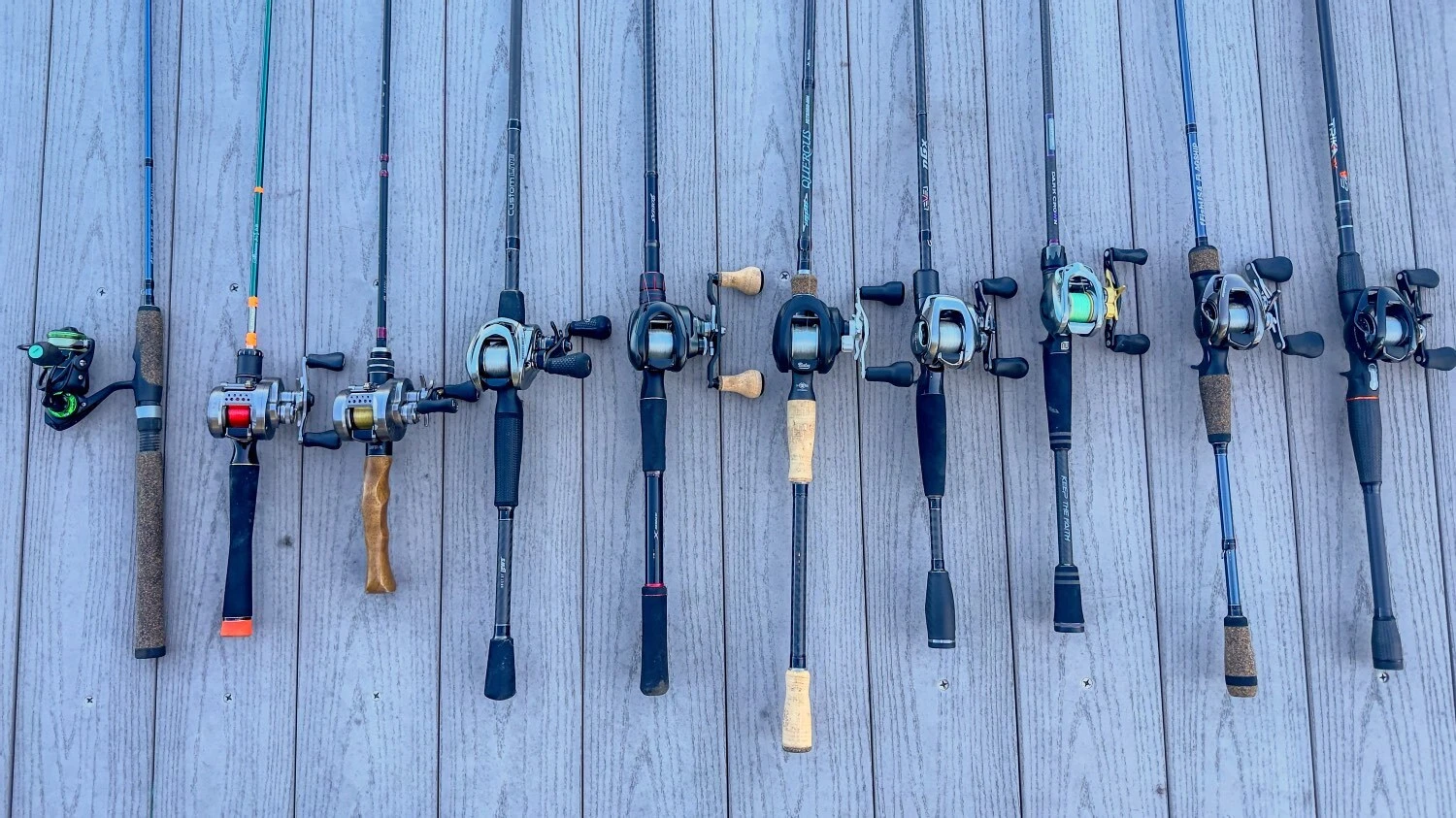
There are more than twice as many rod manufacturers as reel manufacturers in the bass fishing space. FishUSA carries more than 25 brands of bass fishing rods, more than 100 rod series, and more than 1,000 individual rods. If you want to see how those brands stack up against each other, check out our best bass fishing rods guide. Every brand has unique offerings.
Legendary brands that have been making rods for more than 50 years — St. Croix, G. Loomis, Fenwick, Daiwa, Shimano, Shakespeare, and others — all have long histories of building good bass fishing rods. There are also niche and newer brands that have proven their offerings over many years and applications. The upside of so many options is the diversity it gives anglers across many price points and budgets. We’re fortunate to have offerings from larger rod houses, smaller custom shops, and everything in between.
Saying one rod is the best over another is completely subjective, because anglers all fish differently from one another — and that’s partly because we’re all built differently. A 5’8” angler will likely prefer a different style and length of rod than a 6’5” angler. An angler who sets the hook like he’s driving a railroad spike will prefer a different power and action than someone who prefers to finesse the bite. And we often carry brand preferences built up from past experiences. As materials, processes, and companies evolve, newer versions of historic lines fish differently — and can lead us to change those preferences.
The best rod comes down to your personal preferences, experiences, budget, and fishing style. That’s largely why there are so many options. A wide range of anglers are looking for a wide range of preferences in a bass fishing rod. The best rod is often the one you chose after understanding what makes a rod effective and efficient for the techniques you fish — a combination of price to performance, durability, and how the rod feels. That can even include how it makes you feel when you fish with it. Fishing is a passion pursuit, and aesthetics matter to anglers. A rod doesn’t have to be the most expensive or the most technically advanced to be the right rod for you.
As long as the rod is matched to its intended use and fits your budget, you can feel good about the purchase with most reputable brands.
Bass Fishing Rod Price Points
There are some really good rods at the $100 price point. There are also great rods at $300 and beyond. Materials can make some rods much more expensive than others, and manufacturing processes affect price points from line to line and brand to brand.
Every bass fishing rod is capable of catching a bass at some point. Will some be easier to use for certain applications? Absolutely. Will some be more sensitive than others? Of course. That’s often where the price discrepancies come in. But a more expensive rod is not always a better rod for a given application. Sometimes a more durable rod costs far less than a more sensitive one. There are always trade-offs to consider.
Here’s what typically drives the price differences:
- Graphite modulus — higher modulus graphite is lighter and more sensitive, and costs more
- Guide quality — ceramic inserts cost more than stainless steel but are significantly lighter and reduce line wear
- Grip materials — finer cork is more expensive than EVA foam
- Manufacturing precision — tighter tolerances, more consistent blanks, and hand-finishing all add to cost
- Brand positioning — a Megabass rod costs more than a Shakespeare rod because they are building for two completely different buyers with two very different budgets
At the end of the day, evaluate the materials, brand reputation, and reviews to find the combination that matches your personal preferences, style of fishing, and what you consider most important in a rod. We’re here to help you make a good purchase and pick a rod that’ll give you many years of great memories. Reach out with your questions.
Bass Fishing Rod FAQ
It depends entirely on the technique. Light and medium-light power rods are best for finesse applications like drop shots, ned rigs, and small jerkbaits. Medium power works well for treble hook lures like crankbaits and lipless cranks. Medium-heavy covers spinnerbaits, swim jigs, and single-hook moving baits. Heavy and extra-heavy power is for flipping and pitching into cover, frogging over matted vegetation, and throwing large swimbaits on heavy braid. There is no single best power — the right power is the one matched to the technique and lure you’re fishing.
Action refers to how quickly the rod tip rebounds after being deflected — a fast action tip is stiffer and snaps back quickly, while a slow or moderate action loads more gradually. Taper refers to how the bend distributes across the entire blank — a fast taper bends only at the tip, while a slower parabolic taper bends more evenly from tip to butt. A fast-taper rod is better for direct-contact lures like jigs, while a slower-taper rod gives fish more time to engulf treble hook baits before the hookset.
Most bass fishing applications are well-served by rods in the 7 to 7’3” range — long enough for good casting distance and hookset leverage without becoming unwieldy. Longer rods (7’6” and above) are useful for Carolina rigs, big swimbaits, and techniques that require moving a lot of line on the hookset. Shorter rods (6’6” to 6’10”) excel in tight quarters: dock fishing, skipping lures under cover, and pitching in heavy vegetation.
Graphite is the standard for most bass fishing applications because it’s lighter, more sensitive, and more responsive. However, fiberglass has a slower, more parabolic taper that makes it excellent for treble hook crankbaits and moving baits — it absorbs strikes and loads slowly, keeping the fish pinned without pulling hooks. Many tournament anglers keep a fiberglass or composite crankbait rod in the boat for exactly that reason. For most other bass techniques, graphite or graphite composite is the better choice.
There are legitimately good rods at $100 and great rods at $300 and beyond. More expensive rods often use higher-modulus graphite, finer cork, ceramic guide inserts, and more refined manufacturing — translating to better sensitivity, lighter weight, and sometimes better durability. But a more expensive rod isn’t always better for a given application. Sometimes a durable fiberglass crankbait rod costs far less than a high-sensitivity graphite jig rod. Match the rod to the technique, set a budget, then find the best option within that budget from a reputable brand.