

Best Walleye Trolling Crankbaits - Top 4 Lures
Best Walleye Trolling Crankbaits: Top 4 Lures
Trolling crankbaits is one of the most consistent ways to put walleyes in the boat — on big water and small. These are the four crankbaits that serious walleye anglers keep in their spread, with exact depth ranges, trolling speeds, and tips for each.
Last updated: August 2026 · Originally published: October 2022 · By: FishUSA Staff
Why Troll Crankbaits for Walleye?
Trolling crankbaits is one of the most consistently productive methods for catching walleyes across the country — and for good reason. A crankbait covers water at a controlled depth, generates vibration and flash at every pass, and stays in the strike zone the entire time it's running. That's a combination jigging and live-bait rigs can't always match when fish are scattered over a flat or riding a specific depth band.
The best lures for walleye trolling work because walleyes are pursuit predators — they track vibrating, fleeing prey and commit when the trigger response overrides caution. A crankbait running straight and true at the right depth and speed mimics exactly that. Four crankbaits in particular rise above the rest in terms of depth range, fish-catching consistency, and versatility across seasons and water bodies.
Three Ways to Troll Walleye Crankbaits
The same crankbait fishes differently depending on how it's delivered. Understanding the three main methods lets you adapt to changing depth, current, and fish behavior without swapping baits.
Long-Lining on Monofilament
The simplest method and the first one to learn. Let out 75–150 ft of 10–14 lb mono and troll at 1.5–2.0 mph. Mono's stretch serves as a shock absorber on the hook set, reducing pull-offs on hard-striking walleye. At maximum line-out, most deep-diving crankbaits reach their rated depth. This is the baseline setup for 10–22 ft water.
Snap Weights for Extra Depth
Clip a 1–3 oz snap weight onto your line 20–30 ft up from the bait to push it deeper without switching to lead core. Log line-out and weight for every productive pass so you can repeat the combination. Snap weights let you vary depth across your spread quickly — run different weights on different rods to fish multiple levels simultaneously.
Lead Core for Precision Depth Control
Each color of lead core (10 yards) sinks a crankbait roughly 5 ft deeper at trolling speed, depending on bait resistance. Running 2–5 colors of lead core lets you target specific depth bands with precision and repeatability. Lead core is particularly effective when fish are stacked at a consistent depth over an extended trolling run.
Dipsy Divers on Lake Erie
On Lake Erie during summer, dipsy divers let you park shallow-diving crankbaits at a controlled depth while keeping spread lines away from the boat wake. The diver digs down on the troll and releases on a strike — the bait runs behind it on a short lead. This setup excels when fish are holding 15–25 ft in open water with boat traffic.
1. Bandit Walleye Deep Divers
Best For: General trolling in 15–27 ft; any water body, any season. The most versatile walleye crankbait on this list.
You'll be hard-pressed to find a serious walleye angler who doesn't have Bandit Walleye Deeps in their spread. This bait has been around a long time but really took off around 2012, and the reason is simple: Bandit uses oversized rattles that generate a deep, hard-knocking sound unlike any other crankbait at this price point. That rattle gets walleye's attention from distance, and when you pair it with a wide selection of walleye-proven colors — including FishUSA exclusive patterns — you have a bait that consistently produces across different water conditions and light levels.
The Bandit Walleye Deep dives to approximately 27 ft on a long mono lead and tracks true at 1.5–2.2 mph without tuning. Start with firetiger or chrome/purple in stained water and switch to natural baitfish patterns in cleaner conditions.

2. Rapala Down Deep Husky Jerk
Best For: Cold-water trolling, spring spawning season, and whenever fish are lethargic and need a bait that suspends and triggers on the pause.
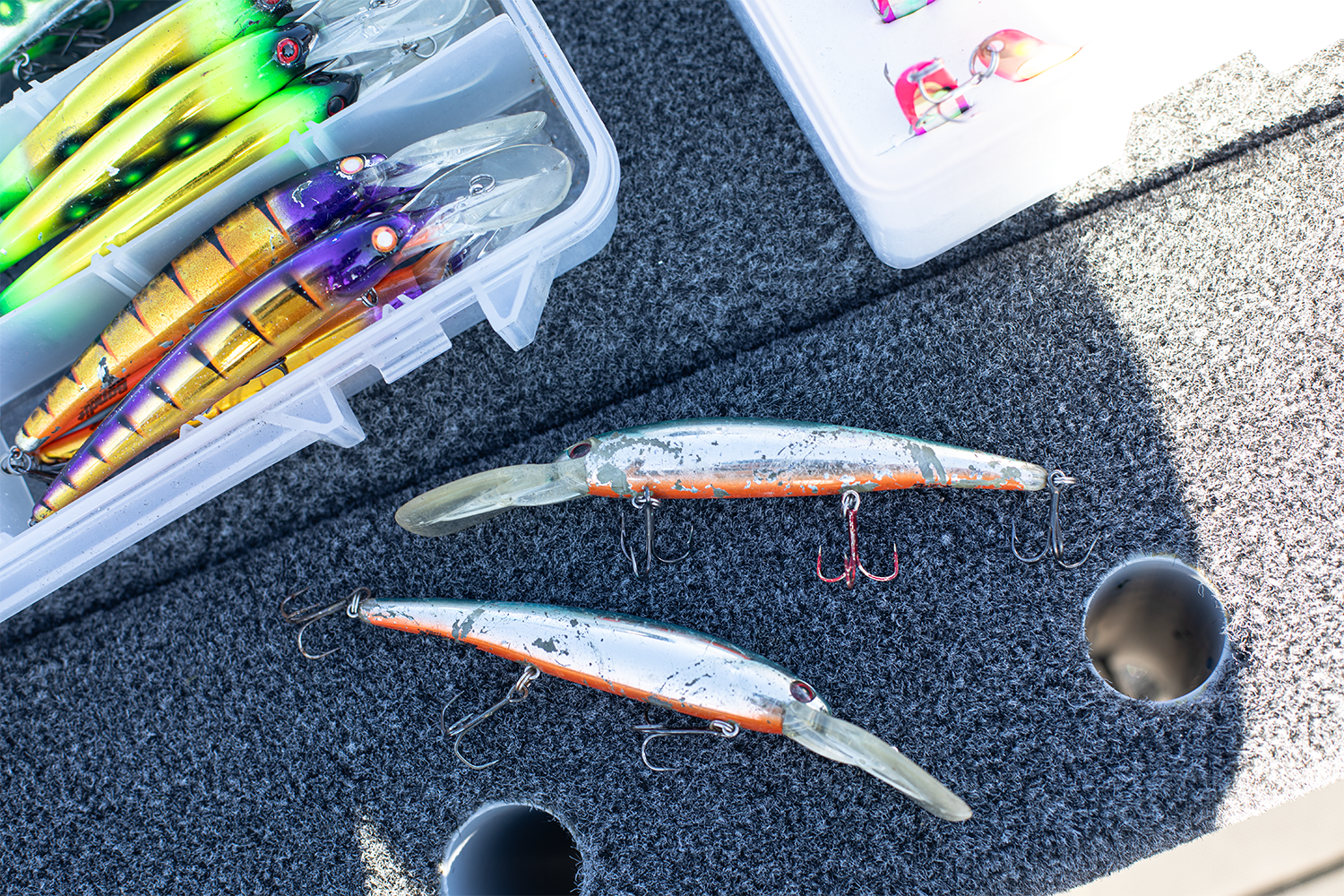
The Rapala Down Deep Husky Jerk is one of the original walleye crankbaits, and it earns its place in this list every season. It's built to troll slow — when other cranks lose their action below 1.5 mph, the DDHJ still produces. The key is its suspending design: troll it into a turn and the bait pauses and hangs in the zone instead of climbing toward the surface. That pause triggers strikes from fish that are tracking but won't commit to a moving bait.
This bait is responsible for big hen walleyes every spring — both pre-spawn fish staging on structure and spawning fish holding in current. The internal rattle adds draw in stained water and chop. Run it on 10–12 lb mono at 1.2–1.8 mph, 75–100 ft back, and check tuning before every spread deployment. Pair it with a short fluorocarbon leader in clear-water situations.

3. Salmo Floating Hornet Crankbaits
Best For: Midwest trolling where fish want a different action than standard hard-plastic cranks; finesse situations where the foam body's unique wobble triggers neutral fish.
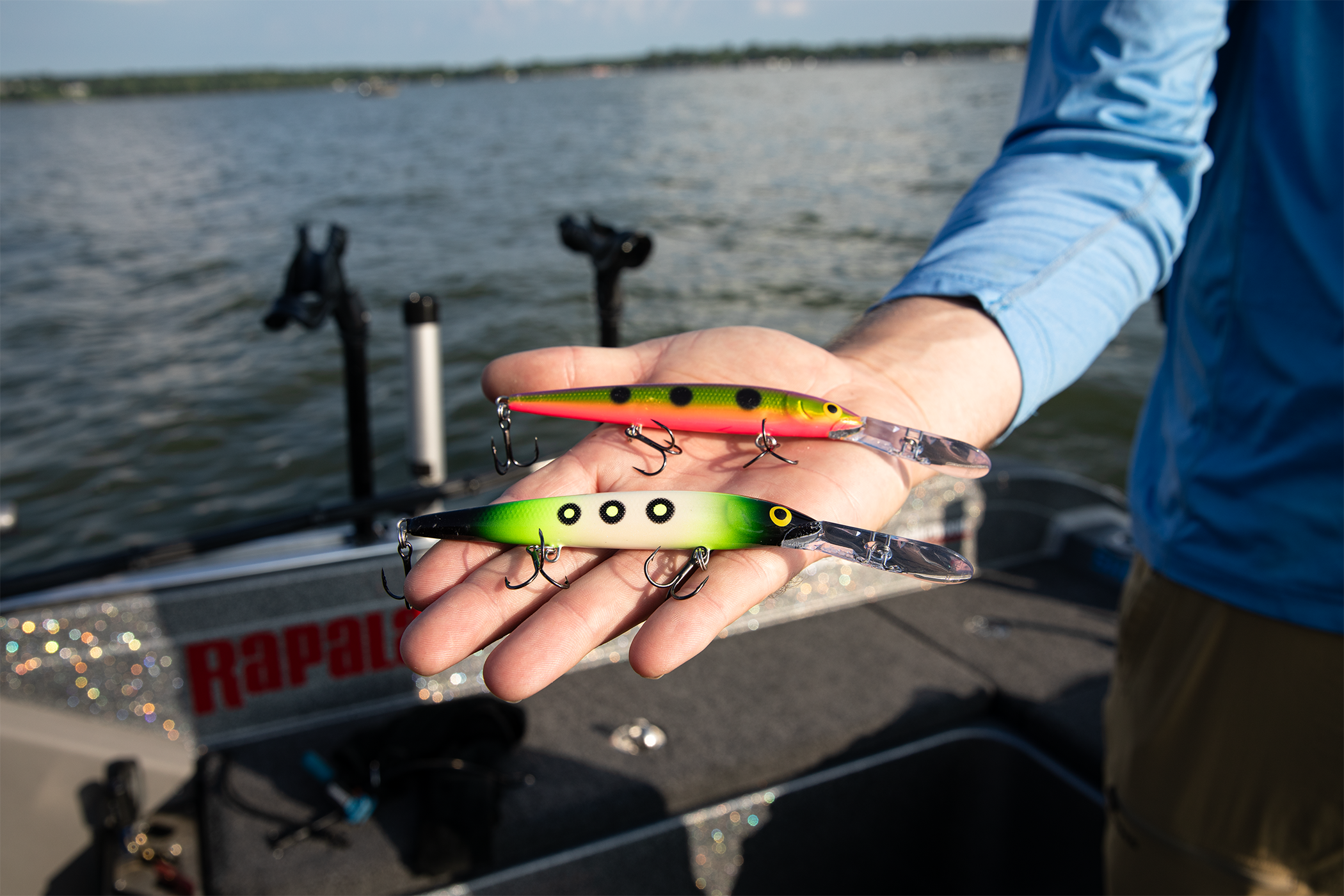
Those who fish Salmo Hornets just know. This is a staple bait across the Midwest — particularly on reservoirs and lake systems where anglers have discovered its foam-body action outperforms hard-plastic cranks when walleye are neutral or pressured. The proprietary foam construction gives the Hornet a buoyancy and roll that hard-plastic baits don't replicate.
The Salmo Hornet also uses wire-through construction, which provides the durability needed when big fish and pike share the same water. It sits a few spots below the Bandit primarily because of a smaller color selection, but FishUSA carries exclusive Hornet colors designed to fill that gap. If you haven't fished one, it's worth adding a few to your spread — the action alone will show you why it has such a loyal following.

4. Rapala Deep Tail Dancer
Best For: Deep-water trolling in 20–30 ft; Lake Erie summer and fall fishing when walleye push deep over open-water bait pods.
The Rapala Deep Tail Dancer is built from balsa, giving it a unique rolling action that plastic cranks can't fully replicate — and that action holds at depth, where most baits start tracking flat. This bait dives up to 30 ft on a standard lead, which makes it one of the deepest-diving crankbaits in any serious walleye spread. That depth capability is what separates it from the pack.
The Deep Tail Dancer shines on Lake Erie during summer when fish are riding the 22–30 ft temperature zone over deep flats. Rapala's color selection is narrower than some competitors, but every color in the lineup is there for a reason — they catch fish. Run it on 10–14 lb mono at 1.5–2.0 mph or on 3–5 colors of lead core when you need to precisely target a specific depth band. Hand-tune each one before the spread — even factory baits benefit from a small adjustment at the nose to dial in the track.
Speed, Line & Tuning Tips
The right crankbait running out of tune at the wrong speed catches nothing. These are the basics that make the difference between a dead spread and a productive one.
Trolling Speed
Start at 1.5 mph and adjust from there. Cold water (under 50°F) generally responds to 1.2–1.6 mph, while warmer water allows 1.8–2.2 mph without killing the bite. Speed changes of 0.2–0.3 mph can be the difference between getting hits and getting nothing — if one speed isn't working, experiment before you change baits. The Bandit and Deep Tail Dancer both handle the wider speed range; the Rapala DDHJ is designed to shine at the slower end.
Line Choice
| Setup | Line | Notes |
|---|---|---|
| Long-line / standard troll | 10–14 lb mono | Stretch reduces pull-offs; reaches rated bait depth at full line-out |
| Braid + leader | 10–20 lb braid + 10–15 ft 12–17 lb fluoro leader | Better feel; leader adds stretch and reduces bait visibility in clear water |
| Lead core | 18–27 lb lead core + 10–15 ft fluoro leader | ~5 ft depth per color; high-visibility core stays out of the strike zone |
| Snap weight rig | 10–14 lb mono + 1–3 oz snap weight | Clip weight 20–30 ft above bait; log exact distances for repeatability |
Tuning Crankbaits
Before any crankbait goes in the water, pull it alongside the boat at trolling speed and watch it track. A bait that veers left means the line tie needs to be bent slightly right; a bait that veers right gets the opposite adjustment. Use needle-nose pliers, make small moves, and check after each adjustment. A properly tuned crankbait runs straight, maximizes its action, and keeps your spread organized. Check after every fish — a hard strike can knock a bait out of tune.
Colors by Condition
- Clear water: Chrome, purple, black/gold, perch, and natural baitfish patterns.
- Stained or green water: Clown, firetiger, chartreuse, and high-contrast two-tone patterns.
- Low light (overcast, dawn, dusk): UV-reactive finishes and glow accents hold visibility longer than natural patterns.
- When nothing is working: Change color first, then speed, then depth — in that order.
Build a Spread, Not a Single Line
Running multiple baits at different depths and speeds lets you dial in what walleye want that day without repeatedly reeling in and re-deploying a single rod. Once you find a producing combination, note line-out, speed, and weight exactly — then run it on every rod you can.
There are a lot of crankbaits for walleye on the market, but these four cover the most important scenarios: broad-spectrum daytime trolling (Bandit), cold-water and spawning-season action (Rapala DDHJ), a foam-body alternative for neutral fish (Salmo Hornet), and true deep-water reach (Deep Tail Dancer). Variety is the spice of life — a variety of crankbaits is the spice for walleye anglers.
Walleye Trolling Crankbait FAQ
The four best walleye trolling crankbaits are the Bandit Walleye Deep (hard-knocking rattle, 27 ft max, widest color selection), Rapala Down Deep Husky Jerk (suspending, cold-water specialist), Salmo Floating Hornet (foam-body action, wire-through build), and Rapala Deep Tail Dancer (balsa-built, dives to 30 ft). Each covers a different depth range and action profile — together they handle nearly every walleye trolling situation.
The Bandit Walleye Deep reaches approximately 27 ft on a long mono lead; the Rapala Deep Tail Dancer hits up to 30 ft. Add snap weights (1–3 oz) or lead core to push any crankbait deeper. Shorter leads produce shallower depths, so match line-out to the depth you're marking fish.
Start at 1.5 mph and adjust. Cold water (under 50°F) typically responds better at 1.2–1.6 mph; warmer conditions allow 1.8–2.2 mph. The Rapala Down Deep Husky Jerk is specifically designed to perform at the slower end — it suspends on turns and triggers lethargic fish in ways faster baits don't.
Monofilament (10–14 lb) is the go-to for most walleye crankbait trolling because its natural stretch absorbs hook sets and reduces pull-offs on thin-wire trebles. If you use braid, pair it with a 10–15 ft fluorocarbon leader (12–17 lb) for stretch and invisibility. Braid works well as a main line on lead core setups.
Pull the bait alongside the boat at trolling speed and watch which direction it tracks. If it runs left, bend the line tie slightly right with needle-nose pliers (and vice versa). Work in small increments and check after each adjustment. Check every bait before your spread and after every hit — a hard strike can knock tuning off.
Yes — long-lining on straight mono (75–150 ft of 10–14 lb) is one of the most effective methods and the simplest to start with. At full line-out, deep-diving cranks reach their rated depth. Add snap weights only when you need to go deeper than the bait's max running depth.
In clear water, chrome, purple, and natural baitfish patterns (perch, silver/black) are consistent producers. In stained water, run clown, firetiger, or chartreuse. For low light — overcast, dawn, dusk — UV-reactive finishes add visibility. If nothing is producing, change color first, then speed, then depth.
For long-line trolling on mono, 75–150 ft covers most situations. To track depth precisely, note line-out and depth for every productive pass and repeat the combination. A line counter reel makes this much easier. With snap weights, track line-out to the weight and line-out from the weight to the bait separately.