

Ice Fishing: Inline vs Spinning Reel – Which Setup Is Best for You?
By: FishUSA Staff
January 22, 2026
If you’ve spent much time on hardwater, you’ve probably heard this debate: ice fishing – inline vs spinning reel, which is better? Most anglers start with a simple spinning reel, then later see seasoned panfish guys running slick inline setups and wonder if they’re missing out. The truth is, both reel types have real strengths and weaknesses, and choosing the right one can make a huge difference in how your lures behave and how many fish you put topside.
If you’ve spent much time on hardwater, you’ve probably heard this debate: ice fishing – inline vs spinning reel, which is better? Most anglers start with a simple spinning reel, then later see seasoned panfish guys running slick inline setups and wonder if they’re missing out. The truth is, both reel types have real strengths and weaknesses, and choosing the right one can make a huge difference in how your lures behave and how many fish you put topside.
In this guide, we’ll break down inline vs spinning reels for ice fishing in plain language. You’ll learn how each reel works, where each shines, and how to match the right reel to your species, depth, and fishing style. Along the way, you’ll get practical setup advice, common mistakes to avoid, and answers to the most common FAQs anglers ask when they’re trying to decide which reel to buy.
By the end, you’ll know exactly which ice fishing reel belongs on each rod in your sled—and how to get the most from both inline and spinning reels on the ice.
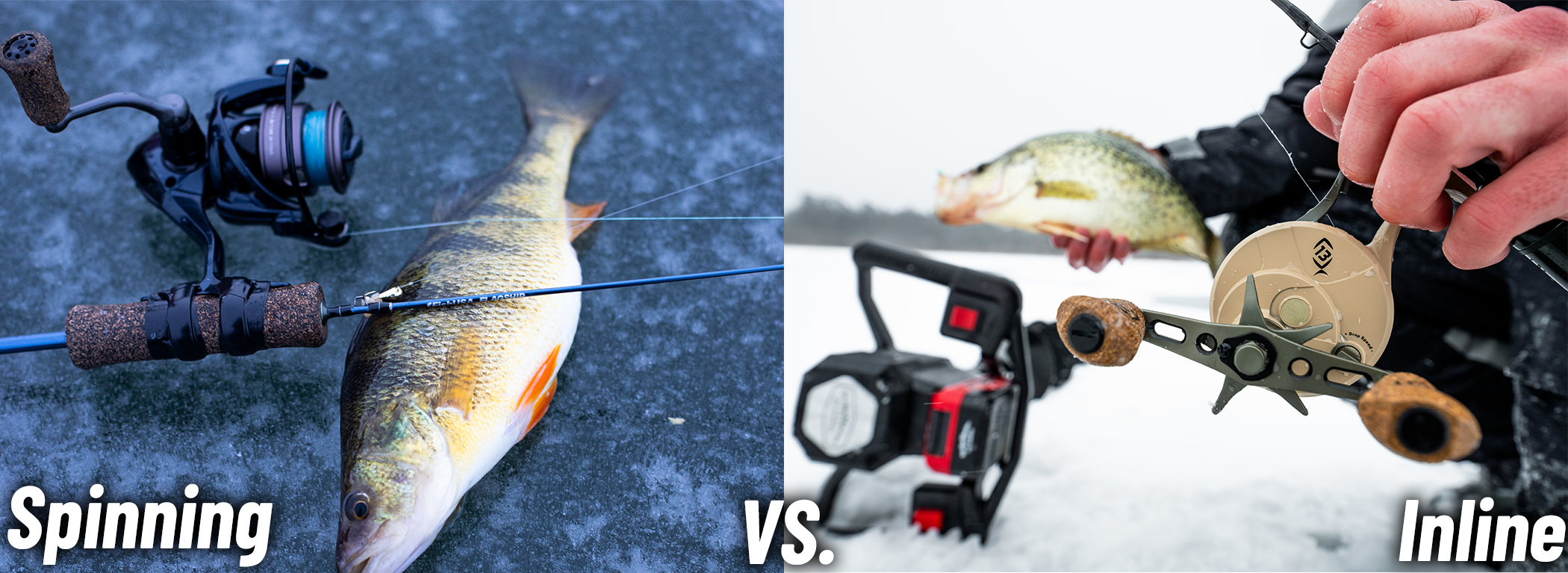
Table of Contents
- Ice Fishing Reel Basics: Inline Reels vs Spinning Reels
- Pros and Cons of Inline Reels for Ice Fishing
- Pros and Cons of Spinning Reels for Ice Fishing
- Inline vs Spinning Reel: Side-by-Side Comparison
- Matching Reel Types to Species and Techniques
- How to Choose Between an Inline and Spinning Reel for Ice Fishing
- FAQs – Inline vs Spinning Reel for Ice Fishing
- Conclusion: Inline vs Spinning Reel – Build the Right Ice Arsenal
Ice Fishing Reel Basics: Inline Reels vs Spinning Reels
What Is an Inline Reel for Ice Fishing?
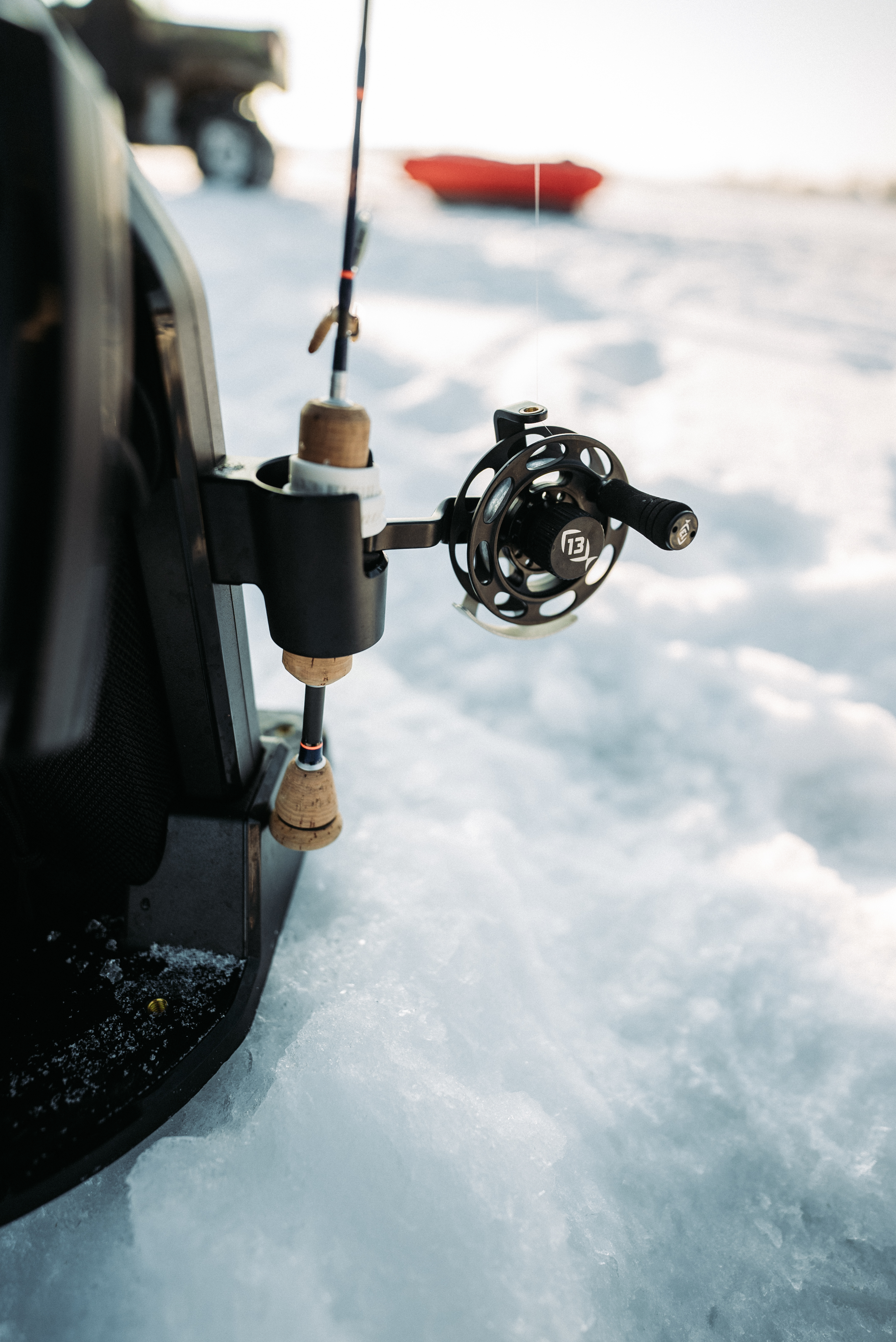
An inline reel for ice fishing is a small, vertically oriented reel where the line comes straight off the spool in line with the rod guides. Instead of wrapping around a fixed spool like a spinning reel, line peels off the top or bottom of an inline spool as you drop your bait.
Key features of inline ice reels include:
- Vertical spool design: Line feeds straight through the guides with minimal twist.
- Free-spool or trigger system: Press a button or lever to let line drop freely to the desired depth.
- Fine depth control: Turn the handle or engage the drag to stop the drop exactly where you want it.
Inline reels were popularized by panfish specialists who wanted straight-down presentations with almost no lure spin—perfect for tiny tungsten jigs and plastics. Over time, they’ve evolved into feature-rich tools for finesse ice anglers.
What Is a Spinning Reel for Ice Fishing?
The spinning reel for ice fishing is simply a compact version of the same spinning reels you use in open water. Line wraps around a fixed spool, and the bail arm lays line as you reel. To drop a lure, you flip the bail, pinch the line, and let it slip through your fingertips.
Spinning reels are popular because they’re:
- Familiar: Most anglers already know how to use them.
- Versatile: You can use the same reel on open water panfish or trout rods.
- Widely available: Every tackle shop carries ice-sized spinning reels at many price points.
For years, spinning reels were the default choice for ice fishing. Inline reels have changed that conversation, especially for panfish and finesse presentations.
Inline vs Spinning Ice Reels at a Glance
At a high level:
- Inline reels: Best for reducing line twist, fishing tiny jigs, and ultra-finesse panfish or shallow walleye.
- Spinning reels: Best for deeper water, heavier lures, larger fish, and anglers who value speed and versatility.
Pros and Cons of Inline Reels for Ice Fishing
Advantages of Inline Ice Reels
Inline reels became popular because they do a few things exceptionally well:
- Minimal line twist: Because line comes straight off the spool, you get far less twist than with a spinning reel. That means your tiny jigs don’t spin in circles and spook finicky fish.
- Straight-down presentations: The line runs in a straight path through the guides, which helps your lure fall naturally and hang perfectly vertical.
- Precise depth control: Free-spool triggers let you drop baits quickly and then stop them exactly where fish show up on your flasher.
- Excellent for finesse: When bluegill, crappie, or pressured walleye want micro baits and subtle movement, inline reels shine.
For anglers who hate watching their plastics spin like helicopter blades on sonar, inline reels can feel like a revelation.
Disadvantages of Inline Reels
Inline reels aren’t perfect, and they’re not ideal for every situation:
- Slower retrieve: Many inline reels retrieve more slowly than spinning reels, which can be frustrating in deep water.
- Learning curve: If you’ve used only spinning reels, getting comfortable with free-spool and vertical spools takes a little time.
- Limited versatility: Most inline reels are ice-specific; they’re not usually something you’d mount on your summer rods.
- Depth and lure limits: Some inline designs struggle with very deep water or very heavy baits, especially budget models with simple drag systems.
Best Situations for Inline Reels on Ice
Inline reels really shine in these scenarios:
- Panfish in shallow to mid-depth water: Bluegill, crappie, and perch in 5–25 feet of water.
- Finesse walleye presentations: Light spoons and small plastics in clear water when fish are shy.
- Pressured lakes: Where fish have seen a ton of spinning-based presentations and are easily spooked by lure spin.
If tiny tungsten jigs, ultra-light line, and “lookers” on sonar are part of your normal life, an inline reel deserves a spot in your sled.
Pros and Cons of Spinning Reels for Ice Fishing
Advantages of Spinning Reels for Ice Anglers
Despite the inline craze, spinning reels remain incredibly popular on the ice—and for good reason:
- Familiar and easy: Most anglers already own and trust spinning reels, so the learning curve is almost zero.
- Fast retrieve: Faster line pickup helps when you’re fishing deeper than 20–30 feet, especially for lake trout or deep basin fish.
- Highly versatile: You can use the same reel for ice fishing and open water, making it a better value if you’re on a budget.
- Broad selection and price range: There are excellent ice-sized spinning reels at nearly every price point.
For anglers who fish multiple seasons and chase a variety of species, a good spinning reel is hard to beat.
Disadvantages of Spinning Reels on Ice
Spinning reels also come with trade-offs, especially in finesse scenarios:
- Line twist: The way line lays on a spinning spool inherently creates twist, leading to lure spin and occasional tangles.
- Coil memory: Especially with mono in cold water, line can coil off the spool, causing loops and reducing sensitivity.
- Freeze-up potential: Ice buildup on the bail, line roller, and spool lip can become a nuisance in extreme cold.
These issues can be managed with good line choices and maintenance, but they never go away entirely.
Best Situations for Spinning Reels on Ice
Spinning reels excel in these situations:
- Deep-water fishing: Lake trout, deep perch, or walleye in 30–60+ feet where fast pickup matters.
- Heavier lures: Spoons, rattle baits, and large swimming lures are more comfortably worked on spinning setups.
- Multi-season use: If you want a reel you can use on soft-water rods as well as ice sticks.
If you chase big fish or fish deep, a spinning reel should be near the top of your ice arsenal.
Inline vs Spinning Reel: Side-by-Side Comparison
Line Management and Twist
Line management is one of the biggest differences in the inline vs spinning reel for ice fishing debate.
- Inline reels: Almost no twist coming off the spool, which keeps micro jigs and plastics from spinning and looking unnatural.
- Spinning reels: Always introduce some twist due to the bail and spool design, especially noticeable with light jigs and mono.
For panfish and finesse walleyes, line twist can be a deal-breaker. For heavier lures and deep water, it is less of an issue.
Sensitivity and Bite Detection
Most sensitivity comes from the rod and line, but reels still play a supporting role. Inline reels’ straighter line path can help micro-rod blanks transmit small ticks. Spinning reels sometimes mask very soft bites when coils and loops absorb shock.
That said, pairing a high-quality spinning reel with a sensitive rod and braid-to-fluoro setup can still be incredibly sensitive. Inline reels simply add another small edge in finesse scenarios.
Depth Control and Drop Speed
Depth control matters when you’re targeting specific layers on sonar:
- Inline reels: Free-spool systems let you “feather” line out and stop on a dime when a mark appears.
- Spinning reels: You’ll use the bail and fingers to control drop, which can be slightly less precise in some setups.
In shallow to mid-depth water, inline reels have a slight edge. In deep water, spinning reels often win due to speed and spool capacity.
Ergonomics and Comfort
Comfort is personal, but a few trends hold true:
- Inline reels: Compact and light, they often feel great on short panfish rods and balance well for hole-hopping.
- Spinning reels: Slightly bulkier but familiar, and often more comfortable for larger hands or gloved fishing.
If possible, handle both reel types with your go-to rod to see which feels more natural for you.
Durability and Cold-Weather Performance
Both inline and spinning reels can perform very well if they’re designed for ice use. Look for:
- Cold-weather lubricants and sealed bearings.
- Quality drags that don’t lock up in sub-freezing temps.
- Minimal exposed moving parts that can ice up.
Well-built reels in either category will outlast bargain-bin options, so it’s worth investing a bit more if you fish hard all winter.
Matching Reel Types to Species and Techniques
Inline vs Spinning Reels for Panfish
For bluegill, crappie, and perch, many serious panfish anglers swear by inline reels:
- Inline: Best for 2–4 lb test, tiny tungsten jigs, and soft plastics where line twist kills the bite.
- Spinning: Still very effective, especially with quality line and occasional twist management (e.g., swivel, line conditioner).
If your main goal is dialing in panfish in 10–25 feet of water, an inline reel is a very smart upgrade.
Inline vs Spinning Reels for Walleye
For walleye, either reel can work extremely well depending on your technique:
- Inline: Great for small spoons, finesse plastics, and clear, shallow water where line behavior heavily influences strikes.
- Spinning: Great for heavier spoons, swimming baits, rattle baits, and deeper water where speed and capacity matter.
A lot of walleye anglers end up with both: an inline rig for finesse and a spinning rig for power and speed.
Inline vs Spinning Reels for Trout, Pike, and Lake Trout
For larger predators and deep-water battles, spinning reels often come out ahead:
- Spinning reels: Better drag systems, larger spools, and better control of big runs.
- Inline reels: Some robust models can work, but most are designed with panfish and finesse in mind.
If you routinely target big lake trout or pike under the ice, a quality spinning reel on a stout rod is the safer bet.
Which Reel Is Better for Beginners?
For new ice anglers, a small spinning reel is usually the best starting point. It’s familiar, forgiving, and versatile. Once a beginner gets comfortable and starts focusing on specific techniques (like finesse panfish), adding an inline reel becomes a logical next step.
How to Choose Between an Inline and Spinning Reel for Ice Fishing
Questions to Ask Before You Buy
To decide between inline vs spinning reels for ice fishing, ask yourself:
- What species do I target most (panfish vs walleye vs big predators)?
- Do I fish shallow, mid-depth, or deep water?
- Do I prioritize finesse and line control, or power and speed?
- Do I need this reel to work for open water as well?
- What’s my budget for reel(s)?
Budget and Value Considerations
Both categories offer budget-friendly and premium options. In general:
- Bargain spinning reels: Can still perform well for casual anglers and kids.
- Mid-range spinning reels: Offer much smoother drags and better cold-weather performance.
- Inline reels: Typically cost a bit more than basic spinning reels, but mid-priced models offer excellent performance for panfish and finesse work.
If you fish a lot, it often makes sense to own at least one good spinning reel and one good inline reel rather than two of the same.
Example Ice Fishing Reel Setups
Here are a few sample setups to illustrate how these reels fit into a real-world arsenal:
- Finesse panfish combo: 24–28" ultralight rod + inline reel + 3 lb fluorocarbon. Perfect for bluegill and crappie on tiny jigs.
- All-around walleye combo: 28–32" medium-light rod + 1000-size spinning reel + 8 lb braid with 6 lb fluoro leader.
- Big fish combo: 36–42" medium or MH rod + 2500-size spinning reel + 10–15 lb braid for trout and pike.
With just two or three combos like these, you can handle nearly any ice fishing situation you’re likely to encounter.
FAQs – Inline vs Spinning Reel for Ice Fishing
Is an inline reel better than a spinning reel for ice fishing?
Inline reels are better for minimizing line twist and presenting small jigs naturally, especially for panfish and finesse walleyes. Spinning reels are better for deep water, heavier lures, and multi-species versatility. Neither is universally “better”—it depends on how and where you fish.
What is the best reel for panfish ice fishing: inline or spinning?
For serious panfish anglers using tiny tungsten jigs and plastics, inline reels often have a clear edge due to reduced line twist. That said, a well-tuned spinning setup can still catch tons of panfish, especially for casual anglers.
Do inline reels really reduce line twist?
Yes. Because the line comes straight off the spool rather than wrapping around a fixed spool, inline reels significantly reduce twist and lure spin. You can still introduce twist through poor handling, but the design itself causes much less twist than a spinning reel.
Can I use my regular spinning reel for ice fishing?
Absolutely. Many anglers use their small open-water spinning reels on ice rods. Just make sure the reel is in good condition, consider using line suited to cold water, and clean and lubricate it appropriately.
Are inline reels good for walleye and deeper water?
Inline reels can be excellent for walleye in shallow to mid-depth water with finesse presentations. In very deep water, however, a spinning reel’s faster retrieve and spool capacity often make it more practical.
Which reel is best for beginners?
Most beginners will be more comfortable starting with a small spinning reel because it feels familiar and has a shorter learning curve. Once they gain confidence and start specializing in finesse tactics, adding an inline reel is a natural upgrade.
How many ice fishing reels do I really need?
You can absolutely get by with one quality spinning reel to start. As you get more serious, owning at least one good spinning reel and one good inline reel lets you cover almost every situation on the ice.
Conclusion: Inline vs Spinning Reel – Build the Right Ice Arsenal
When it comes to ice fishing: inline vs spinning reel, there’s no one-size-fits-all winner. Inline reels offer incredible finesse, natural presentations, and minimal line twist—making them a top choice for serious panfish anglers and finicky walleyes. Spinning reels bring speed, versatility, and power to the table, especially in deep water or when you’re chasing big fish like trout and pike.
The smartest approach is simple: start with a solid spinning reel that fits your main species and depth, then add an inline reel when you’re ready to step up your finesse game. Experiment with both, pay attention to how fish respond on your electronics, and let your experience fine-tune which reel you use for each situation.
If this breakdown helped you understand inline vs spinning reels for ice fishing, share it with a buddy who’s gearing up for the season.
Shop Ice Fishing Gear