

Deep Lake Erie Walleye: Lead Core & Dipsy Diver Tactics
Deep Lake Erie Walleye: Lead Core & Dipsy Diver Tactics
When Lake Erie walleye drop into the deep basin and lock onto smelt, two trolling systems put fish in the boat consistently — segmented lead core line and Dipsy Divers. Lake Erie charter captain and FishUSA Pro Staffer Ross Robertson breaks down both setups: the exact rigging, lures, leader lengths, and techniques that work when walleye go deep.
Last updated: August 2026 · By: Ross Robertson, FishUSA Pro Staff
Setup Overview
Summer walleye on Lake Erie aren’t always the easiest fish to find — but when they’re stacked in the deep basin gorging on smelt, the fish are there. The challenge is getting a lure in front of them at 35 to 45 feet, where they’re holding tight to the thermocline. That’s where lead core line and Dipsy Divers earn their keep.
Both systems let you troll crankbaits at precise, repeatable depths with presentations running well away from the boat. They cover different parts of the spread and work together. Ross Robertson runs both simultaneously — lead core rods for consistency in rough water, diver rods to reach fish at different angles and depths.
| Method | Target Depth | Primary Lure | Primary Line |
|---|---|---|---|
| Lead Core (6 color) | ~42 ft | Deep Jr. Thunderstick – Voodoo Haze | Sufix Performance Lead Core 18 lb |
| Dipsy Diver | Varies by setting | Rapala Jointed Scatter Rap | P-Line EndurX Braid + Shinsei leader |
Why Walleye Go Deep
In summer, Lake Erie walleye in the central and eastern basins follow a predictable pattern: they chase smelt into deep, cold water and hold tight to the thermocline. Smelt are a cold-water baitfish — as surface temps climb, they drop down, and walleye follow. In the deep basin, that productive depth window is usually fairly narrow, often a 20-foot band or tighter, and fish hold within it consistently.
Almost every fish Ross pulls on days like this has fresh smelt in its stomach. That tells you exactly what they’re keying on and gives you the blueprint for lure selection: slim, silver profile, 3 to 5 inches, in colors that suggest baitfish. The Deep Jr. Thunderstick in Voodoo Haze is built for exactly this scenario.
Once you locate the depth window on your graph, the goal is keeping baits in that band consistently at trolling speed. That’s the entire job of lead core and Dipsy Divers: precise, repeatable depth control.
Lead Core Line System
Lead core line gets its depth from the lead core woven inside the braid — weight distributed over the entire length of line rather than concentrated at a single sinker or diver. That distributed weight is a major advantage in rough water. When 4-to-5-foot swells surge the boat, lead core doesn’t swing wildly the way a clip-on sinker would. The presentation stays stable. It’s a big reason lead core produces so well on Erie when conditions turn ugly.
The Segmented Approach
Ross doesn’t spool a full reel of lead core. He segments it — loading a specific number of “colors” onto each reel. Every 30 feet of Sufix Performance Lead Core Line is a different color, so you always know exactly how much lead is out. With the Sufix lead core, Ross gets approximately 7 feet of depth per color. Six colors = roughly 42 feet — right in the smelt zone.
The advantage of segmenting: you can run a small reel. A TR 200 handles six colors of lead without any issues. No expensive line counter reel required — you count colors as they go out, and you always know your depth.
Full System Breakdown
| # | Component | Purpose |
|---|---|---|
| 1 | Small mono base on reel | Arbor backing |
| 2 | P-Line EndurX Braid (40 lb) | Running line backing |
| 3 | 50 ft P-Line CXX Mono + VMC swivel | Board clip point & extra depth (~7 ft) |
| 4 | 6 colors Sufix Lead Core (18 lb) = 180 ft | ~42 ft of depth |
| 5 | VMC swivel | Leader connection point |
| 6 | 30 ft P-Line CXX Mono (12 lb) | Shock absorber + low-visibility leader |
Why the 50 ft Mono Insert?
The 50-foot section of mono between the braid and the lead core serves two purposes. First, it adds roughly 7 extra feet of depth — acting as a free extra “color” without adding more lead to the reel. Second, it gives you a clean clip point for planer boards. Clipping boards onto braid is hard on both the clip and the line. Mono takes that abuse cleanly, and the VMC swivels on each end make connection transitions quick and tangle-free. If there’s a problem on the water, you can trim the mono and retie without touching the lead.
Why 30 ft of Mono Leader?
A 30-foot leader might seem long, but Ross has two solid reasons. Low-vis 12 lb mono keeps the connection well away from the bait in clear Erie water. More importantly, a long leader gives the swivel time to travel up through the guides and past the rod tip before the fish is at the net — reducing the chance of a tangle or snap at the worst possible moment. If something goes wrong mid-fight, you can trim the leader and still finish the day.
Rough water tip: Lead core excels in big waves because the weight is spread across 180 ft of line rather than concentrated at one point. When swells surge the boat, the presentation stays stable. On Erie’s nastiest days, lead core is often the system that keeps producing when everything else falls apart.
Best Lures for Lead Core
A lot of crankbaits run well behind lead core, but when the primary forage is smelt — slim, silvery, and 3 to 5 inches long — one lure stands out above everything else in Ross’s spread.
Storm Deep Jr. Thunderstick — Voodoo Haze (FishUSA Exclusive)
The Storm Deep Jr. Thunderstick in Voodoo Haze is the catcher in this spread. Voodoo Haze is a FishUSA-exclusive color — a translucent, smelt-style pattern with a subtle shimmer that works in both clear and stained conditions. In a smelt fishery, this bait is as close to a perfect forage match as you’re going to find. Ross had multiple fish on it throughout the day, and the limit fish that choked the Thunderstick with a fresh smelt still in its throat. That’s not a coincidence.
The Deep Jr. version dives harder than the standard shallow, which means the bill is doing work to get the bait down faster behind the lead core. Ross occasionally runs the shallow version when he wants a slightly higher running depth, but on a six-color setup targeting 40-plus feet, the Deep Jr. is the call.
Limited edition: Voodoo Haze in the Deep Jr. Thunderstick is a FishUSA exclusive. When they’re gone, they’re gone. The same color is available in the full-size Deep Thunderstick and both shallow versions — each with a different depth profile depending on your spread.
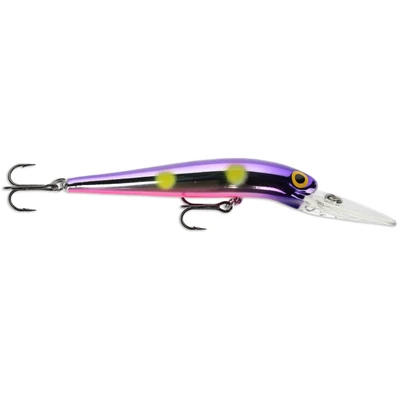
FishUSA Exclusive · Ross Robertson’s pick
Storm Deep Jr. Thunderstick — Voodoo Haze
Smelt-matching profile · Deep-diving · FishUSA exclusive color
Dipsy Diver Setup
Dipsy Divers are diving discs that plane outward and downward at trolling speed, carrying your lure away from the boat at a preset angle and depth before tripping on a strike. They let you spread presentations across the water column at different angles — covering zones the lead core rods can’t reach and putting baits in front of fish that might be holding to the side of the boat’s path. For a full breakdown of Dipsy mechanics, settings, and depth charts, see the How to Use a Dipsy Diver guide.
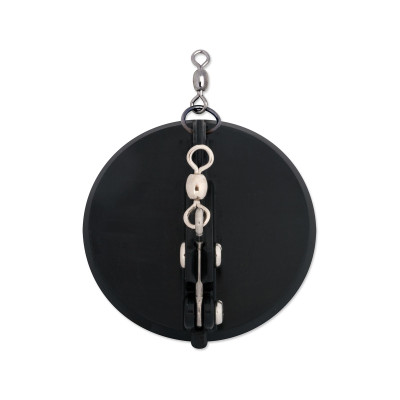
Ross Robertson’s pick
Luhr Jensen Dipsy Diver — Size 1 (Large)
Deep-water walleye · Braid mainline · 9 ft fluoro leader
Leader: Fluorocarbon, 9 ft Minimum
Leader length on a Dipsy rod makes a measurable difference in bites — and most anglers don’t run them long enough. Ross uses a minimum of 9 feet of P-Line Shinsei fluorocarbon in 20 lb between the Dipsy and the lure. That distance keeps the bait well clear of the turbulence and pressure wave created by the diver itself. In clear Erie water, the extra separation matters. Fluorocarbon leader has lower stretch and better abrasion resistance than mono — you’re not burning through leaders every hour.
Adjust leader length by lure type:
- Crankbaits and spinners — 9 ft minimum. If bites are slow, go longer. A few extra feet can be the difference on a pressured day.
- Spoons — shorten the leader. Spoons need more direct action from the diver trip. A long leader can kill the flutter on the reset.
Keep the Clicker On
One of the most common Dipsy mistakes: pulling the clicker off during deployment. The clicker creates drag as line goes out, which controls the drop rate. Without it, the diver can spin out of its set position on the way down — and a diver that spins on deployment is a tangled mess. Yes, the clicking is annoying on the ears. Leave it on anyway.
Tripping the Diver
When a fish hits, the Dipsy trips and collapses out of its diving position. To pull a rod from the spread — for a fish or to reset — use a gentle wrist flick, not a hard sweep. A lot of anglers swing at a Dipsy rod like they’re trying to break something. That aggressive hookset pops fish off. The fish usually hooks itself on the diver trip. A smooth wrist flick trips the diver cleanly; the heavy rod and braid handles the rest.
How do you know a fish is on? Watch the line angle from the rod tip to the water. When a fish hits a tripped diver, that angle changes — it goes higher, pulling up toward the surface rather than angling back and down. A subtle shift in angle on a tight-clicker rod can mean a fish is on even before the rod loads up. Trust the geometry.
Best Lures for Dipsy Divers
Rapala Jointed Scatter Rap — The Scoop Lip Difference
On his diver rods, Ross’s first call is the Rapala Jointed Scatter Rap. The defining feature is the Scatter lip — a cupped, scooped bill that generates a wide, erratic wobble behind the diver instead of the steady side-to-side of a standard crankbait. Rapala makes the Scatter in several formats, but as long as it has the scoop lip, that’s the bait. The jointed version adds an extra tail kick that walleye respond to when fish have seen a lot of traditional presentations.
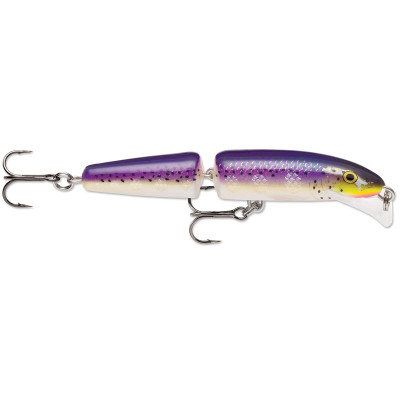
Ross Robertson’s top dipsy lure
Rapala Jointed Scatter Rap
Scoop lip · Erratic action · Jointed tail kick
Downsize Option: Rapala Original Jointed #7
When bites slow or the smelt in the stomachs are running smaller, Ross steps down to the Rapala Original Jointed #7. Going from a 9 cm bait to 7 cm with a smaller bill changes the profile and tones down the action — less wobble, subtler movement. It’s an old-school bait that still earns its spot in the box. If your standard Dipsy rods are getting looks but not converting, a size step down often turns followers into biters.
Color Selection for Deep Water
Color for deep walleye shifts with light conditions, and tracking what’s working and when can turn a decent day into a limit. Ross ran both lead core and Dipsy rods across changing conditions throughout the morning and tracked a clear pattern:
- Overcast / storm conditions — Orange, gold, and darker high-contrast colors produce. These shades stand out in low light and in stained water after rough weather churns things up.
- Sun breaking through — Chrome, purple, and smelt-style natural colors start working. As visibility improves and the water calms, fish key on more realistic baitfish profiles.
- Voodoo Haze specifically — This FishUSA-exclusive color bridges both conditions. It has enough shimmer and translucency to work in low light and enough smelt-like appearance to produce when things brighten up. It was the dominant color in Ross’s spread across every light change during the trip.
When a color is working, replicate it: If one bait is catching and nothing else is, get more of it out immediately. Don’t waste time analyzing why — if you’ve got a catcher, put it on another rod. Ross had the Voodoo Haze producing on every color change and didn’t have enough reels rigged with it.
Fighting Fish & Managing the Spread
Lead Core: Keep the Rod Low
When a fish is on lead core, keep the rod low — nearly parallel to the water. With 180 feet of lead out there, there’s a lot of distributed weight swinging around. A high rod tip turns that weight into a hammer that can tear a hook free as the boat surges through a swell. Keep the rod low, reel steadily, and manage the slack as the boat and fish move relative to each other.
Dipsy Divers: Stay in Line with the Fish
The biggest reason fish come off Dipsy rods: the fish goes sideways. A diver creates significant resistance, and when the fish angles off instead of swimming straight back toward the boat, that combination of diver pressure and lateral angle pops the hook. Watch the fish in the water whenever conditions allow, and move with it. Keep the rod, the diver, and the fish in as straight a line as possible for the entire fight.
Managing Multiple Rods
With a full spread of lead core and Dipsy rods, the other rods become a liability the moment a fish is on. When a fish is on an inside Dipsy, carefully take that rod in and out of the spread as you fight it. Move the outside diver up and around to create separation and avoid tangles. With 180 feet of lead out and Dipsy lines running on angles, the tangle potential is enormous. Manage the spread before it manages you.
Barotrauma in the Deep Basin
Walleye caught deeper than 30 feet in summer don’t survive catch-and-release. The rapid pressure change causes barotrauma — the swim bladder expands, pushing the stomach out through the mouth. Signs include bulging eyes and broken blood vessels visible in the mouth tissue. A fish showing those signs is going home regardless of how healthy it looks swimming away. Factor this into your keeper decisions when fishing the deep basin in summer.
Deep Walleye Trolling FAQ
The key is getting your presentation into the depth zone where fish are holding. Trolling systems like Dipsy Divers and segmented lead core line let you consistently reach deep water while covering ground and keeping baits away from the boat. In Lake Erie’s deep basin during summer, walleye are chasing smelt, so lure profile and color matter as much as depth. The Storm Deep Jr. Thunderstick in Voodoo Haze is the top producer for matching smelt-feeding Erie walleye.
Depth depends on diver size, amount of line deployed, trolling speed, line type, and the diver’s angle setting. The Size 1 (Large) Luhr Jensen Dipsy Diver on braid runs deeper than the same diver on monofilament at the same line length. Checking a Dipsy depth chart gives you a solid baseline for your setup. Adjust the angle setting to spread multiple divers across different zones in the water column.
There isn’t one line that fits every situation. Lead core is ideal for getting crankbaits to precise, repeatable depths without downriggers or diving devices. Braided line is standard for Dipsy Divers — low stretch transfers diver action directly to the lure, and thin diameter lets the diver reach greater depths. Serious Erie anglers run both simultaneously to cover multiple depth windows with different presentations.
Lead core gets lures deep without downriggers or diving devices — using weight distributed across the entire length of line. That distributed weight is a major advantage in rough conditions. When big Erie swells surge the boat, lead core stabilizes the presentation instead of swinging it erratically. The segmented approach gives you repeatable, measurable depth on every rod without a line counter reel, and a small reel handles the job.
It depends on target depth, trolling speed, line weight, and lure. Use depth charts and adjust based on where fish are showing on the graph. With Sufix Performance Lead Core, Ross gets approximately 7 feet of depth per color (30 feet of line per color). Six colors puts his Deep Jr. Thunderstick at roughly 42 feet — where smelt-feeding walleye hold in Erie’s deep basin in summer. Add the 50-foot mono insert for an extra free color of depth without adding lead to the reel.