

Best Topwater Lures for Bass: Walkers, Poppers, Frogs, and Buzzbaits
Best Topwater Lures for Bass: Walkers, Poppers, Frogs & Buzzbaits
Nothing beats watching a bass blow up on the surface. This guide breaks down seven proven topwater lures — what makes each one work, how to fish it, and exactly when to reach for it over the others.
Last updated: August 2026 · By: FishUSA Staff
There is no bite in bass fishing that compares to a surface explosion. The whole hunt plays out in front of you — the blow-up, the miss, the second strike, the hookset — and it never gets old. But topwater fishing is also the category where lure choice matters most. A walking bait in matted weeds is useless. A frog on a windblown flat leaves you throwing past active fish that want something louder. Getting the right style of bait in the right situation is what turns a slow topwater morning into a productive one.
This guide covers seven proven topwater lures across every major style. For each one you’ll find exactly when to tie it on, how to work it, and what the setup looks like. Start with the quick-look table to find your situation, then read into the detail on the baits that match it.
Quick-Look Comparison
| Lure | Style | Best Conditions | Line |
|---|---|---|---|
| Heddon Super Spook Jr. | Walking bait | Calm to light chop; baitfish schools; low light | 12–15 lb mono |
| Yo-Zuri 3DB Pencil Popper | Pencil walker | Long casts on flats; wind lanes; schooling fish | 30–40 lb braid + mono leader |
| Yo-Zuri 3DB Popper | Popper | Docks, shade lines, seawalls; small bait pods | 10–12 lb mono |
| River2Sea Whopper Plopper | Prop bait | Windy banks; riprap; shallow bars; fall bait pushes | 30–40 lb braid + mono leader |
| SPRO Bronzeye Frog 65 | Hollow-body frog | Pads, grass mats, reeds, matted eelgrass | 50–65 lb braid |
| Booyah Pad Crasher | Hollow-body frog | Small lanes in pads; pressure bites; tight gaps | 50–65 lb braid |
| War Eagle Buzzbait | Buzzbait | Low-light banks; submerged grass lines; laydowns | 30–40 lb braid |
What Makes a Great Topwater Lure?
Not every topwater is built the same, and the differences matter on the water. Here’s what separates the baits worth keeping on deck from the ones that collect dust:
- Easy cadence: The best topwaters reward a consistent retrieve without demanding perfect rod work. A bait that walks, pops, or churns without fighting you lets you focus on reading the water, not the lure.
- Hookup ratio: A topwater that sits level, keeps its hooks away from the body, and tracks true will hook more of the fish that blow up on it. Lures that roll over or ride nose-up convert fewer strikes.
- Sound profile: Rattles, single-knock weights, spinning props, and cupped faces all produce different sounds at different ranges. Match the sound to the conditions — louder in wind and stain, more subtle in calm, clear water.
- Cover ability: Weedless frogs and lures with a streamlined shape without dangling trebles move through pads, eelgrass, and reeds cleanly. A bait that hangs up in your target zone is useless.
- Cast distance: Long casts put the lure in front of fish that haven’t seen the boat. This matters most in clear, pressured water where bass spook easily.
Walkers & Poppers
Walking baits and poppers are the core of topwater fishing in open water. Walkers get their action from a rhythmic side-to-side glide — the “walk-the-dog” retrieve — while poppers spit and churn on each rod pop and then pause. Both styles excel in calm to light-chop conditions where bass can lock onto a surface target. The key difference: walkers cover more water and trigger more reaction bites; poppers shine in tight spots where you want the fish to come to a single location and commit.
Heddon Super Spook Jr. — Walking Bait

Best walking bait for open water
Heddon Super Spook Jr.
Walking bait · Loud rattle · Long casting
The Heddon Super Spook Jr. is the walking bait that most bass anglers learn on, and there’s a reason it stays in the rotation long after you’ve tried everything else. It casts a long way, walks with a tight, consistent glide, and carries loud rattles that carry through wind and light chop. On points, seawalls, and flat pockets where bass are chasing shad near the surface, it covers water efficiently and triggers reaction strikes from fish that don’t have time to think.
The key to fishing it right is keeping the rod tip low — pointed at the water, not at 10 o’clock. Snap slack line with short wrist pops rather than pulling the rod back. Done right, the lure walks on its own momentum between snaps. Pause near any obvious ambush point. A lot of the biggest bass you catch on walkers will eat it on a dead stop.
- Best for: Calm to light chop; shad schools near the surface; early morning and evening low-light bites
- Setup: 12–15 lb monofilament — the stretch absorbs missed strikes and the buoyancy keeps the nose riding right. Rod tip down, snap slack, not the lure.
- Pause: Fish that swirl and miss often come back on a dead pause. Let it sit for 3–5 seconds before moving again.
Yo-Zuri 3DB Pencil Popper — Big Walker

Best big walker for distance and wind
Yo-Zuri 3DB Pencil Popper
Pencil walker · Long casting · Single-knock sound
When you need to put the bait on fish that are 70 feet out on a windy flat or blowing up in a wind lane you can barely reach, step up to the Yo-Zuri 3DB Pencil Popper. It throws water on the walk and turns 180° on direction changes, which lets you stall it right in the strike zone before walking it back out again. The single-knock internal weight gives fish a low-frequency sound cue that cuts through surface noise in a chop or wind — something that standard rattles don’t do as effectively.
This is the bait for schooling fish, long casts across open structure, and situations where you need more authority in the water than a smaller walking bait provides. It also handles big largemouth and smallmouth that size up to a larger profile on natural forage.
- Best for: Flats, wind lanes, and schooling fish at distance; largemouth on large shad; open-water smallmouth
- Setup: Moderate-fast rod with 30–40 lb braid and a short 15–20 lb mono or fluorocarbon leader. The leader softens the walk and gives you some stretch for hooksets on long casts.
- Stall trick: Walk it toward you, then stop and let it sit with the nose pointed toward the fish. Many strikes come the moment it stops.
Yo-Zuri 3DB Popper — Popper

Best popper for docks, shade, and tight spots
Yo-Zuri 3DB Popper
Popper · Level sit · Flashy tail hook
A popper is a different tool than a walker — it’s designed to anchor in one place and call fish to it, not to cover water. The Yo-Zuri 3DB Popper sits level on the surface, casts accurately into tight windows, and creates a sharp spit with each pop that bass recognize as a struggling baitfish. The flashy tail hook adds a visual draw on the pause that keeps fish focused on the bait during the lull between pops.
Fish it with rhythm: pop, pause, let the rings spread, pop again. Near docks, shade lines, and seawalls, bass are often holding tight and will commit to a bait that gives them time to look it over. The longer you can make yourself wait on the pause, the better your hook-up rate will be. This is also a great skipping bait under low overhangs on spinning gear with 10–12 lb mono.
- Best for: Docks, shade lines, seawalls, and small bait pods where precision beats distance
- Setup: 10–12 lb mono on spinning or light baitcasting gear for accurate casts and natural skips
- Cadence: Pop, then wait. The pause is more important than the pop. Rings fade, then pop again. Resist the urge to fish it like a walker.
River2Sea Whopper Plopper — Prop Bait

Best prop bait for covering water fast
River2Sea Whopper Plopper
Prop bait · Bubble trail · Straight tracking
The River2Sea Whopper Plopper fills a specific gap in the topwater category: it’s the right tool when you need to move fast and make noise. The rotating tail prop churns a steady bubble trail and tracks straight without any rod work required — just cast and retrieve at a consistent pace. On windy banks, riprap stretches, and shallow structure in the fall when bass are pushing bait, the Plopper covers ground efficiently and stays fishable in conditions where a walking bait loses its action in the chop.
It also handles light grass better than any treble-hook walker or popper — the body shape doesn’t catch weeds the same way, which keeps it clean through areas you’d have to slow down on with other topwaters. When fish are following and swiping short, slow the retrieve down instead of speeding up. A subtle bump in speed can trigger a committed strike from a fish that’s already locked on.
- Best for: Windy banks, riprap, shallow bars, and fall bait pushes; situations where you’re searching for active fish
- Setup: 30–40 lb braid with a short mono or fluorocarbon leader. Steady moderate retrieve — the blade does the work.
- Speed adjustment: Slow down on short strikers; kill the bait and let it deadfall for a split second when fish are tracking but won’t commit.
Hollow-Body Frogs
If there’s a mat of lily pads, eelgrass, or floating vegetation between you and the fish, a hollow-body frog is the only topwater that makes sense. The weedless design slides over anything without snagging, the soft body collapses on the strike to expose the hook, and you can throw it into cover that would immediately tangle a walking bait or popper. Heavy braid is non-negotiable here — when a big bass grabs a frog in heavy cover, you have to be able to move the fish before it wraps you in grass. Keep two frogs with different body shapes in the box so you can change profiles and sound without retying.
SPRO Bronzeye Frog 65 — Hollow-Body Frog
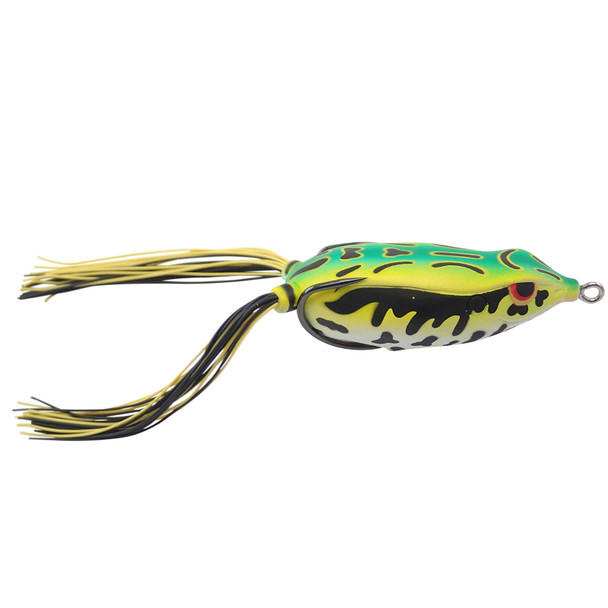
Best frog for pads and heavy cover
SPRO Bronzeye Frog 65
Hollow-body · Weedless · Strong double hook
The SPRO Bronzeye Frog 65 is the most widely trusted hollow-body frog on the market for a reason — it walks easily through pads and mats, skips cleanly under low overhangs, and the body compresses on the strike to expose the double hook reliably. That last part is the whole game with frogs: the soft body has to collapse fully and the hooks have to find skin. The Bronzeye does this consistently, even on short, violent strikes where other frogs let fish get away.
One setup tip worth knowing: bend the hook points out a few degrees with pliers. Stock hooks sit too close to the body and miss skin-hook opportunities on strikes where the fish doesn’t completely engulf the bait. Opening them slightly dramatically improves hookup rate without sacrificing weedlessness.
- Best for: Lily pads, cheese mats, reeds, and matted eelgrass — any cover that would hang up a treble-hook bait
- Setup: Heavy frog rod (7’3”–7’6”, heavy power), 50–65 lb braid. Bend hook points out slightly for better skin-hooks.
- Strike timing: Wait for weight before setting the hook. When the fish blows up, drop your rod tip, feel the fish pull down, then swing hard.
Booyah Pad Crasher — Alternate Frog

Best alternate frog for pressure bites and tight gaps
Booyah Pad Crasher Frog
Hollow-body · Tight walk · Water-shedding design
Keep the Booyah Pad Crasher in the box as your second frog. Its body shape and leg trim produce a different glide and sound than the Bronzeye, which matters when you’re fishing the same stretch of cover on a pressured lake or trying to trigger fish that have already seen the other frog. The Pad Crasher sheds water well after skips, which keeps it from sitting waterlogged and riding low between casts — a real advantage when you’re skipping it repeatedly under docks and through tight gaps in vegetation.
Use short twitches on a slack line to walk it in place over holes and edges in the pads. On a tight walk, the Pad Crasher barely moves — it just churns in position and drives bass holding underneath crazy. Natural and dark color options let you change the silhouette, which can make a real difference in clear water where fish can see the bait clearly from below.
- Best for: Follow-up presentation after the Bronzeye; small lanes between pad clumps; pressured fish that have already seen other frogs
- Setup: Same rig as the Bronzeye — heavy rod, 50–65 lb braid
- Retrieve: Short slack-line twitches for a tight, minimal walk. Pause over any hole or edge in the cover and let it sit.
Buzzbait

Best buzzbait for low-light banks and grass
War Eagle Buzzbait
Buzzbait · Fast rise · Squeaking blade
Buzzbaits are search baits. When you need to cover a long bank, run a grass line, or find active fish at first light, the War Eagle Buzzbait moves faster and makes more noise than any walking bait or popper. It rises quickly to the surface after the cast, tracks straight at varied speeds, and the blade squeak gives fish an auditory cue that carries across distance and through wind. You can fish it through light grass and around shallow wood that would foul most other topwaters.
The retrieve has to start immediately after the lure hits the water — don’t let it sink or you’ll lose the blade to the bottom. Once it’s running, maintain a steady pace that keeps the blade just on the surface. A toad or swimbait trailer adds lift, reduces rolling, and changes the profile. Use 30–40 lb braid and set the hook on the weight of the fish, not on the surface explosion — the hook is usually already in the fish by the time you see the strike.
- Best for: Low-light hours along banks and grass lines; searching for active fish before dialing in with a more precise bait
- Setup: 30–40 lb braid, heavy power rod. Start the retrieve the moment the lure lands. Add a toad trailer to change lift and profile.
- Hookset: Don’t react to the explosion — feel the weight and sweep. Most missed hooksets on buzzbaits are from setting too early.
When to Fish Each Style
| Situation | Best Choice | Why |
|---|---|---|
| Calm morning, shad on surface | Heddon Super Spook Jr. | Matches baitfish profile; walks easily in calm |
| Wind or chop, fish out of reach | Yo-Zuri 3DB Pencil Popper | Longer cast, louder action that tracks in waves |
| Tight spot — dock, shade line, seawall | Yo-Zuri 3DB Popper | Holds position, calls fish to it rather than covering water |
| Covering water fast, windy bank | River2Sea Whopper Plopper | No rod work needed; steady retrieve in rough conditions |
| Pads, mats, dense vegetation | SPRO Bronzeye Frog 65 | Weedless; collapses on strike for better hookup |
| Pressured frog water, tight gaps | Booyah Pad Crasher | Different profile and sound to trigger fish that saw the Bronzeye |
| Low-light run along banks or grass | War Eagle Buzzbait | Covers the most water, loudest surface noise, fast-rising blade |
| Followers that won’t commit | Change style entirely | Switch sound profile (rattle to single-knock), or slow down and kill it |
Quick picks by condition
- Clear water, calm morning: Heddon Super Spook Jr. or Yo-Zuri 3DB Popper
- Windy flats or open water: Yo-Zuri 3DB Pencil Popper or River2Sea Whopper Plopper
- Pads, mats, and thick cover: SPRO Bronzeye Frog 65 or Booyah Pad Crasher
- Covering water at first light: War Eagle Buzzbait
Keep five styles on deck. A productive topwater session rarely runs on one bait. Start with a buzzbait to find active fish, switch to a walker when they’re showing on the surface, drop to a popper when they get selective, and have a frog ready the moment the bank turns to heavy cover. The angler who changes baits based on what the fish are telling them will always outfish the one who commits to a single presentation all morning.
Frequently Asked Questions
It depends on the situation. For open water and baitfish schools, a walking bait like the Heddon Super Spook Jr. or pencil walker like the Yo-Zuri 3DB Pencil Popper is hard to beat. In tight spots, a popper like the Yo-Zuri 3DB Popper excels. The River2Sea Whopper Plopper covers water fast on windy banks. For heavy cover, the SPRO Bronzeye Frog 65 or Booyah Pad Crasher are the go-to. At first light along a bank or grass line, start with the War Eagle Buzzbait to find active fish.
Early morning and late evening are the most reliable windows, especially in summer when bass are shallow in low light and retreat once the sun climbs. Overcast days extend the topwater bite through midday. Spring and fall are the strongest overall seasons — bass are active in the shallows and less pressured by heat. In summer, target the first and last hour of light along grass edges, shaded docks, and shallow cover.
Line choice depends on the lure. For walking baits and poppers, 10–15 lb monofilament is the classic choice — the stretch absorbs missed strikes and keeps lures floating properly. For pencil walkers and prop baits on long casts, 30–40 lb braid with a short mono leader works well. For buzzbaits and frogs in heavy cover, go straight 30–65 lb braid — you need the strength to pull fish out of vegetation without the stretch that lets them bury deeper in the mat.
Keep the rod tip low — pointed at the water, not at 10 o’clock — and use short, rhythmic wrist snaps to pull slack line, not to pull the lure. The lure should walk on its own momentum between snaps. The most common mistake is working the rod too high, which lifts the nose instead of walking it. Pause near every piece of cover and let the lure sit still. A lot of big bass strike on a dead stop, not during the walk.
Start the retrieve the instant the lure hits the water — let it sink and the blade goes to the bottom. Take up slack as it lands and start cranking. Keep the rod tip up enough to hold the blade on the surface, but not so high you pull the hook up on the strike. A steady moderate retrieve works most of the time. When fish are following but not committing, bump the speed briefly to trigger a reaction, or kill it for a split second and let it deadfall. Set the hook on the weight of the fish, not the explosion.
Yes — hollow-body frogs are specifically built for cover that would hang up any treble-hook topwater. The SPRO Bronzeye Frog 65 and Booyah Pad Crasher slide over lily pads, through grass mats, and skip under overhangs that are completely inaccessible to walkers or poppers. Use 50–65 lb braid and a heavy frog rod. When the fish blows up, wait a beat before setting — let it pull the bait under, feel the weight, then swing hard.
Let the lure sit completely still for several seconds — the fish usually circles back. If it doesn’t commit after two or three attempts, note the exact spot and come back in a few minutes with a different bait. A soft plastic on a follow-up cast converts a lot of missed topwater fish. If you’re getting multiple short strikes in a session, change the sound profile first (switch from rattles to single-knock), then try slowing way down. Speeding up after a short strike almost always drives the fish away.