

The Best Trout Spoons: Top Picks for Trout Fishing Success
The Best Trout Spoons
Six proven spoons that trigger strikes in rivers, lakes, and streams — from lightweight finesse lures to heavy deep-water killers. Size, color, and technique breakdowns for every situation.
Last updated: August 2026 · By: FishUSA Staff
Trout spoons are one of the most effective and versatile lures you can carry — and one of the most underrated by anglers who grew up on soft plastics and jigs. The wobbling, flashing, fluttering action is built into the shape itself. Cast it out, reel it back, and a well-designed spoon mimics a wounded baitfish convincingly enough to fool even pressured trout in gin-clear water. Add the fact that spoons cast farther than most other lures of the same weight, and it’s easy to see why they’ve been a staple of trout fishing for over a century.
This guide covers six of the best trout spoons available at FishUSA — each with a proven track record on rainbow trout, brown trout, brook trout, lake trout, and steelhead. We break down what makes each spoon unique, what conditions it excels in, and how to fish it effectively. If you want to expand beyond spoons, see our full guides to the best trout lures and the best trout bait.
Quick-Look Comparison
| Spoon | Best For | Weight Range | Action | Top Conditions |
|---|---|---|---|---|
| Acme Kastmaster | Long casts, deep water | 1/32–3/4 oz | Tight wobble, fast sink | Lakes, deep runs, fast current |
| Acme Little Cleo | Rainbow trout, steelhead | 1/8–1¼ oz | Wide wobble, fluttering fall | Rivers, lakes, night fishing |
| Acme Phoebe | Small water, brown trout | 1/16–1/4 oz | Lifelike wobble, subtle flash | Creeks, streams, ice fishing |
| Luhr Jensen Krocodile | Trophy trout, deep water | 1/4–3+ oz | Slow, hypnotic wobble | Deep lakes, reservoirs |
| Eppinger Dardevle | Stained water, all-around | 1/4–1 oz | Classic wide wobble | Rivers, shore casting, trolling |
| Thomas Buoyant | Cold water, slow retrieves | 1/6–5/8 oz | Erratic wobble at slow speed | Mountain streams, early spring |
Acme Kastmaster Spoon

Best overall trout spoon
Acme Kastmaster Spoon
1/32–3/4 oz · Chrome, Gold, Copper, Chartreuse
The Acme Kastmaster is the most recognized trout spoon on the market, and after decades of consistent performance it still earns that title. Its flat-angled front profile creates a tight, fast wobble that closely mimics a disoriented minnow — not the slow, wide swing of a traditional spoon, but a quick side-to-side shimmy that trout respond to aggressively. The real advantage is casting distance: the Kastmaster’s dense, compact body cuts through wind and carries farther than almost any lure of the same weight, which matters when fish are holding deep or across a wide lake where most casters can’t reach.
Key features
- Profile: Flat-angled front creates a tight wobble and fast, direct sink rate that gets the lure to depth quickly without excessive line bow.
- Size range: 1/32 oz for ultra-light stream fishing up to 3/4 oz for lake trout, salmon, and steelhead in bigger water.
- Top colors: Chrome/Chartreuse and Chrome/Neon Blue Stripe are consistent producers; standard Chrome and Gold cover clear-water and low-light situations; Copper works well in tannin-stained rivers.
When to use it
The Kastmaster excels in deep water, fast current, and any situation that rewards long casts. In lakes, fan-cast across structure or count it down to depth and retrieve at a pace that keeps the wobble going. In rivers, cast upstream into a fast run and reel just fast enough to maintain tension as the spoon sweeps through the strike zone — it holds depth better than wider-profile spoons in heavy current. A quick retrieve near the surface in low light can also trigger explosive strikes from actively feeding trout.
Acme Little Cleo Spoon

Best for rainbow trout & steelhead
Acme Little Cleo Spoon
1/8–1¼ oz · Nickel, Hammered, Glow finishes
The Acme Little Cleo has earned a permanent place in trout and steelhead fishing for one simple reason: its action on the fall is as effective as its action on the retrieve. Where the Kastmaster sinks fast and straight, the Little Cleo flutters and helicopters on slack line, triggering reaction strikes from fish that aren’t actively chasing. Cast it out, let it helicopter to depth, then retrieve with a slightly erratic cadence — pause, crank, pause — and it mimics a wounded baitfish convincingly. The hammered finish option scatters light in all directions, adding an extra flash dimension in off-color water that can make the difference when fish are hard to trigger.
Key features
- Finishes: Both smooth and hammered options available — hammered creates micro-flashes that scatter light and add attraction in stained or turbid water.
- Size range: 1/8 oz for smaller trout streams up to 1¼ oz for steelhead rivers and large lakes.
- Top colors: Nickel Neon Blue and Nickel Neon Green are proven day-fishing colors; glow finishes make the Little Cleo one of the few spoons worth fishing after dark or in deep water where light penetration is minimal.
When to use it
The Little Cleo is the go-to spoon for larger rivers and lakes where trout are holding at depth or actively feeding on baitfish. Cast across the current, mend slightly upstream, and let the spoon swing through the strike zone on a controlled retrieve. At night or in off-color water, glow finishes paired with a Nickel base are hard to beat. For steelhead, step up in size — 3/8–1 oz in nickel or hammered finishes is a trusted Great Lakes and Pacific Northwest combination.
Acme Phoebe Spoon

Best for small water & brown trout
Acme Phoebe Spoon
Lightweight · Metallic Perch, Brown Trout, Copper
The Acme Phoebe is the most visually realistic spoon in the Acme lineup. Its unique curved body with protruding fin detail creates a wobble that looks less like a generic lure flash and more like an actual small fish trying to escape — subtle, darting, alive. That realism pays off in clear-water situations where trout get a long look and need convincing. The Phoebe is a particularly effective choice on pressured fish that have already seen dozens of flashier spoons and have learned to pass on them.
Key features
- Design: Curved body with hammered texture and molded fin detail creates maximum visual realism at any retrieve speed.
- Weight: Lightweight options make it ideal for small-water fishing where heavy lures spook trout or snag bottom in shallow runs.
- Top colors: Metallic Perch and Brown Trout are the standout patterns in clear water; Copper excels in tannin-stained creeks where warmer tones outperform silver.
When to use it
The Phoebe is at its best in small creeks, mountain streams, and any water where visual presentation matters more than casting distance. It’s also a legitimate ice fishing option — drop it through the hole and jig with short, twitchy lifts to imitate a fleeing minnow. For brown trout specifically, the Phoebe’s realistic profile and subtle action often outperform louder, flashier spoons. Fish it on a slow to medium retrieve in clear, shallow water and let the detail do the work.
Luhr Jensen Krocodile Spoon

Best for trophy trout & deep water
Luhr Jensen Krocodile Spoon
1/4–3+ oz · Chrome, Firetiger, Hammered finishes
The Luhr Jensen Krocodile is built for anglers chasing big trout in big water. Its elongated, heavy-bodied profile sinks fast, holds depth through the retrieve, and produces a slow, hypnotic wobble well-suited to targeting lake trout, large brown trout, and trophy rainbows holding deep and keyed in on larger prey. The small red paddle near the treble hook simulates blood from an injured baitfish — a secondary trigger that sets the Krocodile apart from standard chrome spoons when trout are examining lures closely before committing.
Key features
- Profile: Long, narrow body — exceeding 3 inches in larger sizes — mimics the big baitfish that trophy-class trout prefer over small insects or minnows.
- Red paddle: A small red tab near the hook simulates a bleeding baitfish, adding a visual strike trigger beyond the flash of the body.
- Durability: Heavy-gauge construction handles rocks, structure, and the powerful jaw of large trout and salmon without bending or losing finish.
When to use it
The Krocodile earns its spot when you’re fishing deep lakes and reservoirs — particularly during summer when trout drop to the thermocline and hold 20–40 feet down. Count it down to depth before retrieving, or troll it behind a boat at a slow speed that keeps the wobble going. In rivers, heavier Krocodile sizes are effective for steelhead in high, fast conditions where you need a lure that can hold depth without being swept above fish before they can react.
Eppinger Dardevle Spoon

Best all-around trout spoon
Eppinger Dardevle Spoon
1/4–1 oz · Red/White, Chartreuse, Diamond patterns
The Eppinger Dardevle has been catching trout since 1906 — a longer track record than any other spoon on this list. That longevity reflects a design that simply produces across a wide range of conditions, species, and water types. The classic wide-body spoon creates a pronounced wobble that telegraphs well in off-color water, making the Dardevle especially valuable when stained conditions would otherwise limit lure visibility. Fish can detect the Dardevle’s heavy side-to-side motion through their lateral line even when visual range is measured in inches rather than feet.
Key features
- Classic design: Wide-body spoon shape delivers a pronounced side-to-side wobble that fish can detect even in near-zero visibility.
- Size range: 1/4 oz for smaller water up to 1 oz for trolling and lake casting.
- Top colors: Red/White Stripe is the most legendary trout color in the Dardevle lineup; Chartreuse/Green Stripe and Chartreuse/Fluorescent Orange Diamonds are go-to choices in muddy or off-color water.
When to use it
The Dardevle is the lure to reach for in off-color water — after rain events, in rivers with glacial or silt-heavy flow, or anywhere water clarity drops below three feet. Its wide profile and bold color patterns give trout a large, visible target to lock on and track. Shore casting, river swings, and slow trolling all work well. The Red/White pattern is particularly effective early and late in the season when trout are aggressive and willing to chase a large, high-contrast lure.
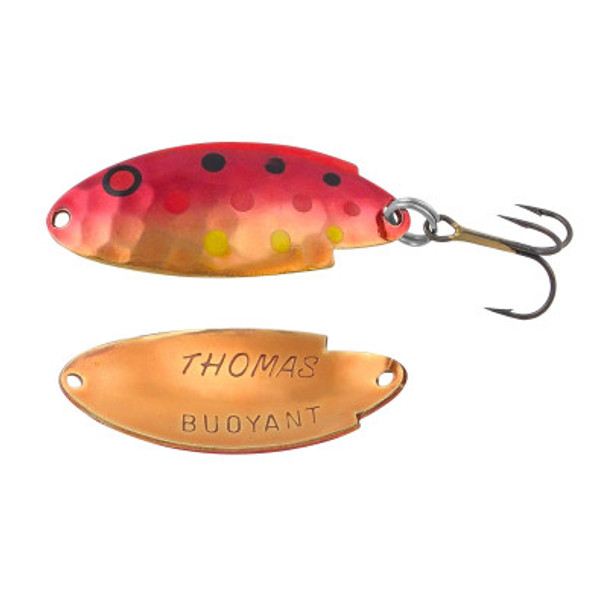
Thomas Buoyant Spoon
Best for cold water & slow retrieves
Thomas Buoyant Spoon
1/6–5/8 oz · Unique two-sided color finish
The Thomas Buoyant earns its name: it’s engineered to maintain action at retrieve speeds where most spoons go dead. That slow-speed capability is invaluable in cold water, where trout’s metabolism drops and they’re simply not willing to burn energy chasing fast-moving lures. The Buoyant’s asymmetrical bend and offset cutouts create an erratic, darting wobble that keeps working even on a near-crawl retrieve — exactly the presentation cold-water trout need to commit. The unique two-sided finish, where each face of the spoon carries a different color or tone, creates a contrast flash effect as it wobbles that stands out from standard single-finish spoons.
Key features
- Slow-speed action: Asymmetrical bend and cutout design keeps the spoon wobbling at retrieve speeds that would kill the action on most standard spoons.
- Size range: 1/6 oz and 1/4 oz for small-water trout; 1/2 oz and 5/8 oz for larger fish and deeper water.
- Two-sided finish: Each side carries a different color or finish, creating a contrast flash effect as it wobbles — a unique feature in the spoon category.
When to use it
The Thomas Buoyant is most at home in mountain creeks, cold tailwaters, and early spring lake fishing when trout haven’t fully activated yet. It’s also an excellent small-stream lure where short casts and precise placement matter more than distance. For rainbow and brook trout in small to medium rivers, slow-roll the Buoyant through pools and slower runs where fish are holding and waiting for food to come to them — don’t make them work to catch it.
How to Choose the Right Trout Spoon
Every spoon on this list will catch trout — the question is which one fits your specific conditions. Two factors drive the decision: water type and the depth or speed at which you need to fish. A Kastmaster built for distance and fast sink has no advantage on a small creek where you need a slow, accurate presentation. A Phoebe designed for subtle clear-water action won’t hold up in fast current or stained water. Match the spoon to the conditions first, then dial in color.
| Situation | Best Choice | Why It Works |
|---|---|---|
| Deep lake / reservoir | Kastmaster or Krocodile | Dense bodies sink fast and hold depth on the retrieve |
| Fast river current | Kastmaster or Little Cleo | Weight stays in the strike zone without getting swept above fish |
| Small stream / creek | Phoebe or Buoyant | Lightweight, accurate cast, and active at slow retrieve speeds |
| Stained / off-color water | Dardevle or Little Cleo (hammered) | Bold patterns and scattered flash give trout a visible target |
| Cold water / slow bite | Thomas Buoyant | Maintains wobble at crawl-speed when trout won’t chase |
| Night fishing | Little Cleo (glow finish) | The only spoon on this list with a proven glow option after dark |
| Trophy / big trout | Krocodile or Dardevle (large) | Larger profile matches the big prey that trophy fish prefer |
| Steelhead | Little Cleo or Krocodile | Larger sizes, strong wobble, holds up in fast river current |
On color: in clear water, match the local baitfish — chrome and silver for shad and smelt, gold and copper for perch and shiners. When clarity drops, shift to high-contrast patterns. Chartreuse, neon blue, orange, and the classic red/white all give trout a larger, brighter target to track. In very dirty water, the Dardevle’s bold patterns or the Little Cleo glow finishes are your best options.
Line tip: For most trout spoon fishing, 4–8 lb monofilament or fluorocarbon balances action, hook-setting, and visibility. Use braid with a fluorocarbon leader only when you need extra casting distance with lightweight spoons. Heavy line kills the wobble on smaller spoons and increases visibility in clear water — go lighter than you think you need to.
Trout Spoon FAQ
The Acme Kastmaster is the best starting point for beginners. It casts farther than almost any other spoon of the same weight — which means you can reach fish without mastering a specific technique. The tight wobble and fast sink rate do most of the work, and a simple steady retrieve is enough to trigger strikes in most trout fisheries.
For most stream and lake trout fishing, 1/8–1/4 oz covers the majority of situations. Use lighter sizes (1/16–1/8 oz) in small, clear streams where fish need a subtle presentation. Step up to 3/8–5/8 oz for larger lakes, deeper reservoirs, and rivers with heavy current. Trophy hunting in deep water or for steelhead calls for 3/4 oz and up.
In clear water, chrome, gold, and copper metallic finishes best mimic natural baitfish flash. In stained or off-color water, shift to high-contrast patterns — chartreuse, red/white, neon blue, and neon green give trout a visible target. Gold outperforms silver in low light. In very dirty water, glow finishes on the Little Cleo are the most reliable option.
Yes — spoons are excellent river lures. Cast across or slightly upstream, let the spoon sink to the right depth, then retrieve at a pace that keeps it wobbling through the current. The Kastmaster and Little Cleo handle fast current well due to their dense bodies. In slower pools and runs, the Thomas Buoyant and Acme Phoebe stay active at the slower retrieves needed for fish holding in slack water.
The Kastmaster has a compact, angular shape with a tight, fast wobble and exceptional casting distance — ideal for open water, deep lakes, and fast currents. The Little Cleo has a wider, traditional spoon profile that creates a broader, more erratic wobble and a pronounced flutter on the fall. Choose the Little Cleo when trout want a slower, wider-swinging presentation or when strikes come on the drop rather than the retrieve.
Start with a steady medium-speed retrieve — fast enough to keep the spoon wobbling, slow enough for trout to track it. Add occasional pauses and let the spoon flutter on slack line; following fish often strike on the fall. In rivers, cast across or upstream and maintain slight tension as the spoon swings through the strike zone. Vary speed until you feel the wobble, then stay consistent until fish respond.
Yes. The Little Cleo is the best-known steelhead spoon on this list, particularly in 3/8–1 oz with nickel or hammered finishes in Great Lakes tributaries and Pacific Northwest rivers. The Krocodile also performs well in bigger, faster flows. Match size to conditions — heavier in high, fast water to hold depth; lighter in low, clear conditions when steelhead are spooky.
For most trout spoon fishing, 4–8 lb monofilament or fluorocarbon is ideal. Mono’s natural stretch cushions strikes on treble hooks. Fluorocarbon’s near-invisibility is an advantage in clear water. If you need extra distance with lightweight spoons, run 8 lb braid with a 4–6 lb fluorocarbon leader. Avoid heavy line — it kills spoon action, reduces casting distance, and increases visibility in clear conditions.