

Best Trolling Spoon Sizes for Lake Ontario Salmon & Trout
Best Trolling Spoon Sizes for Lake Ontario Salmon & Trout
FishUSA Pro Staffer and Lake Ontario charter captain Rick Hajecki breaks down when to run Super Slim, Regular, and Magnum trolling spoons — species by species, season by season — plus his deadly late-summer two-spoon rig.
Last updated: August 2026 · By: FishUSA Staff
Color gets most of the attention in trolling spoon discussions — but size is just as important, and often more so. A perfectly colored spoon in the wrong size for the species or the forage available can sit untouched while the right-sized presentation gets hammered. On Lake Ontario, where you might be targeting king salmon, brown trout, steelhead, and coho all in the same trip, understanding when to switch sizes is a skill that separates productive spreads from frustrating ones.
In the Dreamweaver lineup — one of the most widely trusted spoon brands on Lake Ontario — there are three main sizes in the trolling spread: the Super Slim (3 5/8”), the Regular DW (3 3/4”), and the Magnum (4 3/4”). Each has a specific role depending on the target species, the time of year, and what baitfish are present in the water column. FishUSA Pro Staffer and Lake Ontario charter captain Rick Hajecki has fished all three across thousands of hours on the lake — and in this guide, he breaks down exactly when and why he reaches for each one. Also see Rick’s top Lake Ontario trolling spoon colors for the complete picture.
Watch: Rick Hajecki on Trolling Spoon Sizes for Lake Ontario
In this FishUSA video, Rick walks through the three Dreamweaver spoon sizes directly on the boat, explains what species and conditions call for each, and reveals the two-spoon setup he considers one of his most effective late-season presentations.
Spoon Sizes at a Glance
| Size | Measurement | Best Species | Best Season / Use | Product |
|---|---|---|---|---|
| Super Slim | 3 5/8” | Brown trout, steelhead | Year-round browns; May–June steelhead | Dreamweaver Super Slim |
| Regular (DW) | 3 3/4” | All salmon species | Spring slider; late-season main line | Dreamweaver DW |
| Magnum | 4 3/4” | King salmon | Spring main line; late-season pin cheater | Dreamweaver Magnum |
Super Slim — 3 5/8”
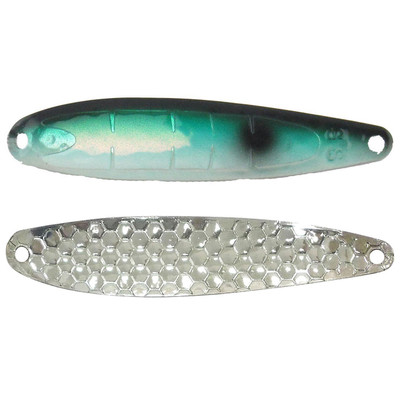
Brown trout & steelhead specialist
Dreamweaver Super Slim Spoon
3 5/8” · Narrow profile · Tight wobble
The Super Slim is Rick’s go-to whenever brown trout or steelhead are the primary target. At 3 5/8”, it’s the smallest of the three Dreamweaver sizes, with a narrower body that produces a tighter, more subtle wobble than the wider DW or Magnum profiles. That subtle action closely matches the smaller baitfish — juvenile alewives, gobies, and smelt — that brown trout and steelhead key on throughout the season.
In the spring, brown trout move to the shoreline early, and the Super Slim is the first spoon Rick reaches for. It stays in rotation for browns all summer long. For steelhead, Rick specifically targets May and June — spring into early summer — as the prime window for the Super Slim. “Steelhead absolutely love this spoon,” Rick says, adding that specific colors like the Rockfather have been consistent steelhead producers for him over the years.
- Spring brown trout: Rick’s first choice as browns move to the shoreline — the Super Slim’s profile matches the smaller forage browns are targeting in cold, shallow water
- Summer brown trout: Stays in the spread all summer for browns; larger Magnum presentations rarely outperform the Super Slim on this species
- May–June steelhead: The Super Slim’s action and size profile is a natural fit for steelhead, which respond strongly to the narrower presentation
Regular DW — 3 3/4”
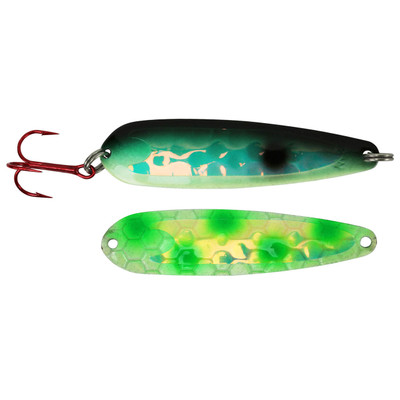
All-season salmon workhorse
Dreamweaver DW Series Spoon
3 3/4” · Standard profile · Slider & main-line versatile
The Regular DW is the most versatile spoon in Rick’s spread — the size he reaches for when salmon are the target and conditions don’t specifically call for the Magnum’s larger profile. At 3 3/4”, it splits the difference between the subtle Super Slim and the large Magnum, producing a wide wobble at trolling speed that works on Coho and Chinook salmon across the full range of Lake Ontario conditions.
In the spring, Rick typically runs the Regular DW as a slider spoon — a cheater rigged on a sliding clip and tossed off the back of the downrigger so it rides above the main spoon. “The regular size is a great slider spoon,” Rick explains. “We’ll generally throw this on a sliding cheater, toss it overboard, and we’re running both of these on the same line when we’re fishing on a downrigger.” That two-spoon setup — a Regular sliding above a Magnum — is one of Rick’s core spring presentations. As the season progresses into late summer, the Regular moves to the main line while the Magnum takes over as the pin cheater above it (see the Mag Cheater section below).
- Spring slider: Rigged as a sliding cheater above the Magnum on a downrigger — lets you run two sizes simultaneously without adding a second rod to the spread
- All-season salmon: The most consistently productive salmon size across changing conditions throughout the season; keeps producing when the bite slows on other sizes
- Late-season main line: Transitions to the main downrigger line in summer and fall as Rick switches the Magnum to a pin cheater above it
Magnum — 4 3/4”
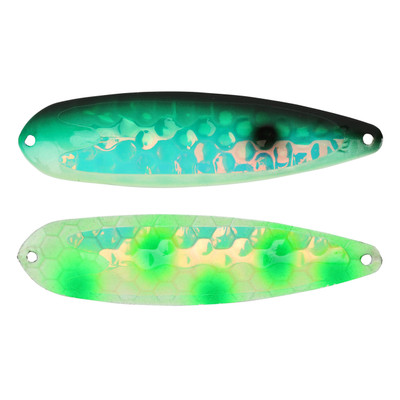
King salmon — Spring & deep late-season
Dreamweaver Magnum Series Spoon
4 3/4” · Large profile · Mature alewife match
The Magnum is the big-fish spoon — and the forage-matching logic behind it is straightforward. In spring, mature alewives that have been living in deep water all winter move into the shallows to spawn. Those fish are full-sized — larger than the juvenile alewives that make up most of the summer baitfish picture — and king salmon lock onto them hard. “Those alewife are mature alewife. They’re larger alewife, and we tend to do very well on mags earlier in the spring,” Rick explains. Running the Magnum in cold, early-season water on the main line of a downrigger or behind a diver puts a large, wobbling profile in front of kings that are feeding aggressively on big baitfish.
Later in the season, the Magnum shifts roles entirely. Rather than fishing it on the main line, Rick uses it as a pin cheater — fixed 10 feet above a Regular DW spoon on the same downrigger line. This two-spoon combo, which Rick calls the “mag cheater,” becomes his most effective late-summer salmon presentation once the thermal layer drops to 50, 60, or 70 feet and deeper. See the dedicated section below for the full setup breakdown.
- Spring main line: Fished on the main downrigger line or behind a diver in cold, early-season water when mature alewives are the dominant forage
- Forage matching: At 4 3/4”, the Magnum directly matches the size of full-grown alewives that spring salmon are actively targeting — a more precise match than any smaller spoon
- Late-season pin cheater: Transitions to a fixed cheater 10 feet above the Regular DW on a downrigger — Rick’s go-to setup once the thermal climb deepens
Rick’s Mag Cheater Rig
The setup: Regular DW spoon on the main downrigger line → Magnum spoon pinned as a fixed cheater 10 feet above it on the same line. Rick calls this the “mag cheater” and considers it one of his most effective late-summer Lake Ontario presentations.
One of the most valuable pieces of information Rick shares in the video is a specific two-spoon rigging technique he uses later in the season. Earlier in spring, he runs the Magnum on the main line and the Regular as a sliding cheater above it. But once the season progresses — and once the thermal layer descends to 50, 60, or even 70 feet and deeper in late summer — Rick flips the setup. The Regular moves to the main line, and the Magnum is fixed as a pin cheater 10 feet above it.
“Later on in the year through my client setup, I usually like to switch these up — use the regular on the main, and I pin the mag 10 feet above it, and use a pin cheater for that,” Rick explains. “That is a really deadly presentation for us on Lake Ontario.” The logic: as salmon move deeper to follow the cold-water thermocline, the larger Magnum hanging above the main spoon acts as a visual attractor at depth, drawing fish down from above while the Regular provides a secondary target below. The combination covers two depths and two size profiles simultaneously, maximizing the presentation’s reach in a single rod.
This rig works specifically once the thermal climb is established deep in the water column — a summer and early fall condition on Lake Ontario. If you’re fishing before the thermocline sets up, stick with the spring configuration of Magnum on the main and Regular as a slider.
Moonshine Trolling Spoon Sizes
The Dreamweaver lineup covers the three primary size categories for Lake Ontario trolling, but Moonshine Lures offers complementary spoon profiles worth running alongside them. The Moonshine Standard Trolling Spoon is sized comparably to the Dreamweaver DW, making it a natural pairing in a mixed spread. The Moonshine Half Moon Spoon occupies its own unique profile category — its half-glow, half-chrome ladder-back design creates a different visual signature than any flat or cupped spoon and is particularly effective on the high rigger for steelhead and salmon in the morning hours.
| Moonshine Spoon | Comparable Size | Key Differentiator | Best Use |
|---|---|---|---|
| Moonshine Standard | Similar to DW Regular | Glow & UV finish options | Salmon — all depths; pairs with Dreamweaver in spread |
| Moonshine Half Moon | Unique profile | Half-glow / half-chrome ladder back | High rigger for steelhead & morning salmon |
Seasonal Size Guide: When to Run Each Spoon
The most important variable driving spoon size selection on Lake Ontario is the available forage — specifically the size and behavior of alewives at different points in the season. Here’s how Rick’s size decisions map to the Lake Ontario season:
| Season / Period | Conditions | Primary Size | Secondary Size | Species Focus |
|---|---|---|---|---|
| Spring (Apr–May) | Cold water; mature alewives spawning nearshore | Magnum (main line) | Regular (slider cheater) | King salmon; spring Coho |
| Spring (Apr–June) | Nearshore, shallow; browns active | Super Slim | — | Brown trout, steelhead |
| Early summer (May–June) | Steelhead in the spread | Super Slim | Regular | Steelhead; mixed species |
| Summer (July–Aug) | Thermal climb building; deeper fish | Regular (main line) | Super Slim (browns) | All species; browns on Super Slim |
| Late summer / fall (Aug–Sept) | Thermal layer at 50–70+ ft deep | Regular (main line) + Magnum (pin cheater 10 ft above) | Super Slim (high rigger) | King salmon; late Coho |
Match size to forage, not just species
The underlying principle behind Rick’s size decisions isn’t simply “big fish = big spoon.” It’s about matching the prevalent forage at that moment. In spring, mature alewives drive the Magnum bite. In summer, as juvenile baitfish dominate the water column, the Regular and Super Slim become more effective even when targeting large kings. Paying attention to baitfish size on the sonar — and adjusting spoon size accordingly — produces more bites than sticking with a fixed size based on the calendar alone.
Spread tip: Run all three sizes simultaneously to cover multiple species and depths in one pass. A typical Rick Hajecki spread might include Super Slim spoons on the high riggers for browns and steelhead, Regular DW spoons on mid-depth riggers for general salmon, and a Magnum pin cheater on the deep rigger for kings once the thermal climb is established.
Frequently Asked Questions
It depends on species and season. In spring when mature alewives are spawning nearshore, Magnum spoons (4 3/4”) are most effective for king salmon. The Regular DW (3 3/4”) is the most versatile all-season salmon size. For brown trout and steelhead, the Super Slim (3 5/8”) is the go-to throughout the season. Running a mix of all three covers the full range of Lake Ontario species and conditions simultaneously.
The Super Slim is the primary choice for brown trout in spring and all summer long, and for steelhead in May and June. Its narrower profile and tighter wobble matches smaller baitfish that trout key on. Rick Hajecki reaches for it any time brown trout or steelhead are the primary target in the spread, and keeps it in rotation year-round for browns regardless of what other species are being targeted.
Run Magnums in two main scenarios. First, in early spring when mature alewives are moving nearshore to spawn — the Magnum’s 4 3/4” profile matches that larger forage and produces aggressive spring king salmon strikes on the main downrigger line. Second, as a pin cheater fixed 10 feet above a Regular spoon in late summer, once the thermal layer drops to 50 feet or deeper — Rick’s “mag cheater” rig that he considers one of his most effective late-season presentations.
In the Dreamweaver lineup: the Super Slim is 3 5/8” with a narrow profile and tight wobble — best for brown trout and steelhead. The Regular DW is 3 3/4” — a versatile, wider-body spoon for all salmon species. The Magnum is 4 3/4” — the largest profile, designed for king salmon and large-baitfish scenarios. All three are available in the same color patterns, so you can run the right size for each species without giving up a productive color.
The mag cheater is a two-spoon presentation where a Regular DW spoon is rigged on the main downrigger line, and a Magnum spoon is fixed as a pin cheater 10 feet above it on the same line. Rick considers it one of his most effective late-summer salmon setups, especially once the thermal layer drops to 50, 60, or 70 feet deep. The Magnum acts as a large visual attractor above while the Regular below provides a secondary target — covering two depths and two size profiles with a single rod.
Yes — matching spoon size to the target species is one of the most reliable ways to improve catch rates. Brown trout and steelhead respond best to the Super Slim. Coho and king salmon are effectively targeted with the Regular DW. King salmon in spring and deep-water late-summer setups call for the Magnum. Running mixed sizes across your downriggers lets you target multiple species simultaneously without sacrificing effectiveness for any one of them.
Yes, significantly. Brown trout on Lake Ontario feed heavily on smaller baitfish like gobies and juvenile alewives, and they respond much better to the Super Slim’s subtle, narrower presentation than to the Magnum’s larger profile. Rick Hajecki uses the Super Slim exclusively when brown trout are the target — from spring shoreline fishing through the full summer season. The Super Slim consistently outperforms larger spoon sizes on browns in virtually all conditions.